... that Kamara was right? Africa use to be great.
Alvin Kamara and Making Africa Great Again
Some readers may recall Saints Running Back Alvin Kamara (#41) wearing a headband saying “Make Africa Great Again”, during the 2018-2019 football season. Indeed by 1200 AD (by the Middle Ages), before the time of European incursions into the Continent via the Atlantic, many societies of Sub-Sahara Africa had achieved greatness. The reports of Islamic Arab travelers and the first Europeans explorers to West Africa attest to the greatness of West Africa. They found the area teaming with people, before the Islamic and European incursions. They had to have had large populations in order to supply the millions and millions of people who were brought to the New World and taken across the Sahara.
They were agriculturists, farmers, for the most part. They were able to sustain the large populations because they produced lots of food, enough food to sustain the dense populations and still have some left over. The Europeans went there to trade in goods, and they did that, but eventually the trade turned into trading in people more than in goods.
The West Africans were prolific traders with trade routes crisscrossing the region. This trade was with North Africa, Egypt, the Sudan, East Africa, within the Western Sudan, and other parts of the Continent. It was one of the keys to their to their being able to accumulate wealth of the magnitude of that achieved by the Kingdom of Mali in the 1300’s that allowed kankan Mansa Musa to make a lavish pilgrimage to Mecca, spreading so gold along the way that economies of the Middle East were disrupted with an inflation that lasted for years. This was about a decade after the former Emperor, his brother Abubakari the Second, had outfitted two massive fleets of ships to explore lands, which they believed existed, to the west across the Atlantic. Abubakari himself headed up the second expedition across the seas. They di not return to Mali but there is ample evidence that they made it to the Americas and greatly impacted Medieval American culture, especially in Mexico.
These Africans knew how to do things. They excelled in different types of artisanry. For example, they knew how to produce the iron (almost all African people knew iron smelting by the beginning of the Christian era) which was used to produce the implements, such as hoes and shovels, needed to cultivate the many crops they produced. Many of these crops, such as rice, they had domesticated themselves.
The area where Kamara’s family comes from, Liberia, was part of what was called, by early Europeans, the Rice Coast or the Grain Coast, from Senegal to Liberia. Before America established Monrovia in Liberia, the Liberians had been producing rice for perhaps several thousand, but certainly many hundreds of, years, using very sophisticated systems of irrigation and flood control. Along this Rice Coast, the people produced enough rice and grains to supply the slave ships with provisions for their return voyages, with their shameful cargoes! Historians Judith A. Carney (Black Rice) and Peter Wood (Black Majority) convincingly established the fact that Africans brought rice, which they had domesticated, with them and showed the white South Carolinians, and others, how to grow it, how to harvest it, and how to cook it. (Carney and Wood are not black nor afro-centric scholars, for those who might think that the authors are black folk tooting the horns of black folk). The slaves taught the masters.
Isn’t it ironic that there are projects established to teach Africans how to feed themselves? And yet 500 years ago, Africans not only fed themselves, but a great deal of the rest of the world too. I wonder if Alvin Kamara’s reflecting on his greatness led him to wonder why Africa could not be great again. There is no question about the greatness of Kamara as an athlete. And it is not just brawn that makes him great; he has to have brains also to do what he does. To me, he is poetry in motion on the football field! Africa can be great again. However, that has to be the subject of a much longer treatise than this blog post.
... three extraordinary African plants: yam bean, icacina, and tamarind
In my last blog on West African domesticated plants, I promised to tell you something about the plants on the list that you probably know nothing about. Instead of describing them all in one post, I will spread them out over several weeks. Sometimes I will also talk about some of the plants you may have heard of but may not know much about them. As you will see, some of these plants have extraordinary and wonderful characteristics and properties.
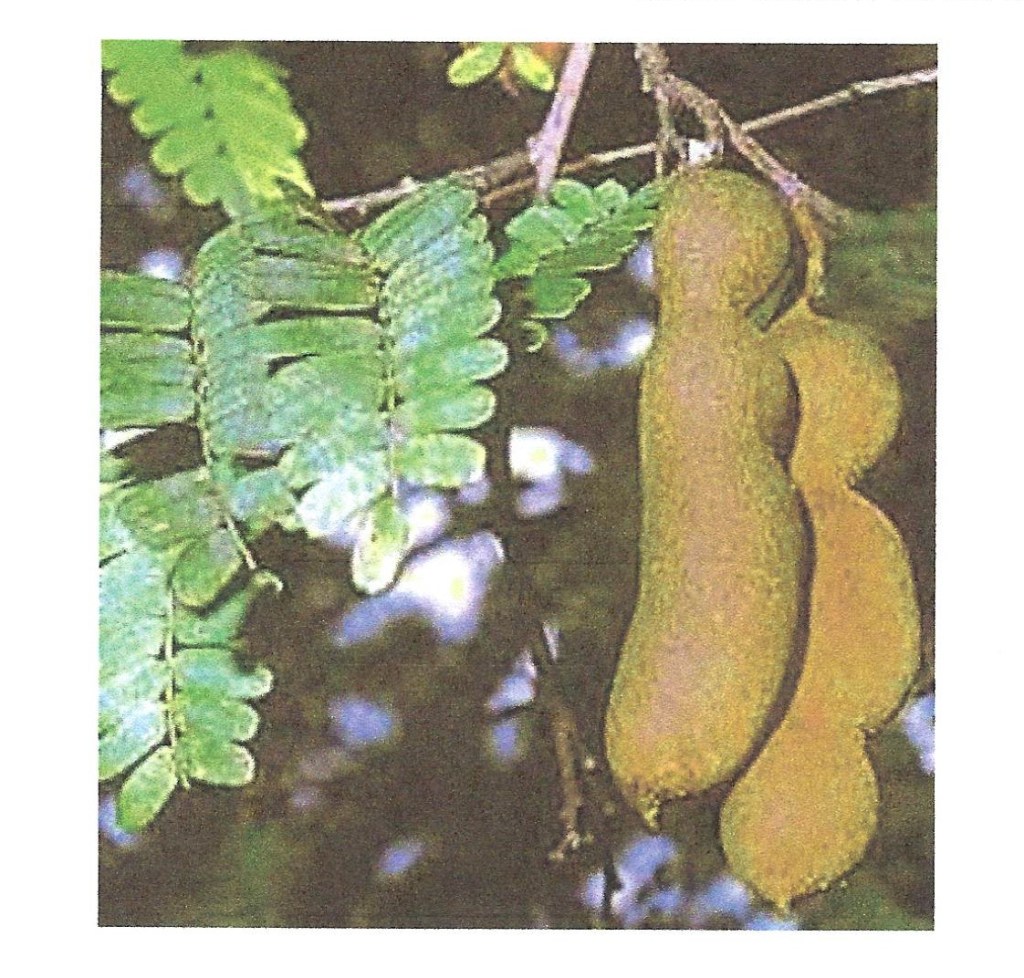
Below I describe three plants of African origin, with pictures of the plants. The featured image above is a Tamarind Tree taken from Lost Crops of Africa, V. III.
Yam bean
“There are two yam beans: one with its origin in the Americas and the other in West Africa… the African yambean is closely related to the American version and also is grown for its fleshy swollen roots” 1
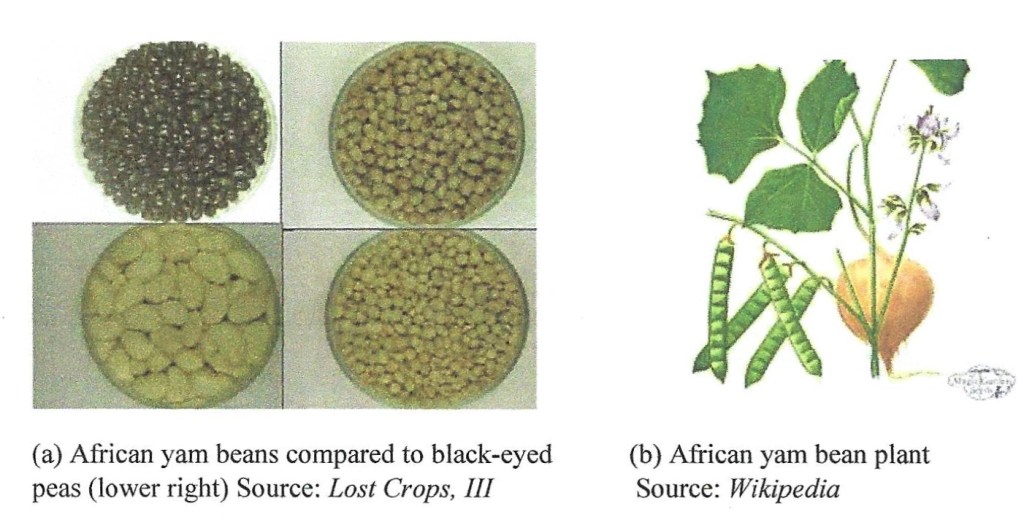
The African yam bean plant produces edible seeds and leaves in addition to elongated edible tubers which look more like sweet potatoes than yams.
“In nutritional terms, they are a class above the mainline root crops, containing more than twice the protein of sweet potatoes, yams, or potatoes and more than ten times that of cassava. Moreover, the protein is of exceptional nutritional quality… Eating African yambean together with those major foods helps provide the body a “complete protein.” The combination, in other words, closely matches the chemical requirement for constructing the thousands of separate proteins human bodies need to make constantly.”2 .
Uses: “… the yambeans’ swollen underground stems are succulent, white, sweet, mildly flavored, and crisp as a fresh-picked apple. They can be eaten out of hand. They can be used to add crunch to green salads and fruit salads. They can be steamed or boiled, and have the unusual property of retaining their crispness even under conditions that convert potato to mash. In cooked form they taste like potato, but whereas it averages 5 percent protein, African yambean tubers have from 11 to 19 percent protein (on a dry-weight basis).” (p. 326) (2)
“The invisible bacterial microbes inhabiting its roots relieve the farmer of the necessity to supply additional nitrogenous fertilizer. This is, in other words, a food source that supports itself while helping both the soils under it and the species that succeed it.
Icacina
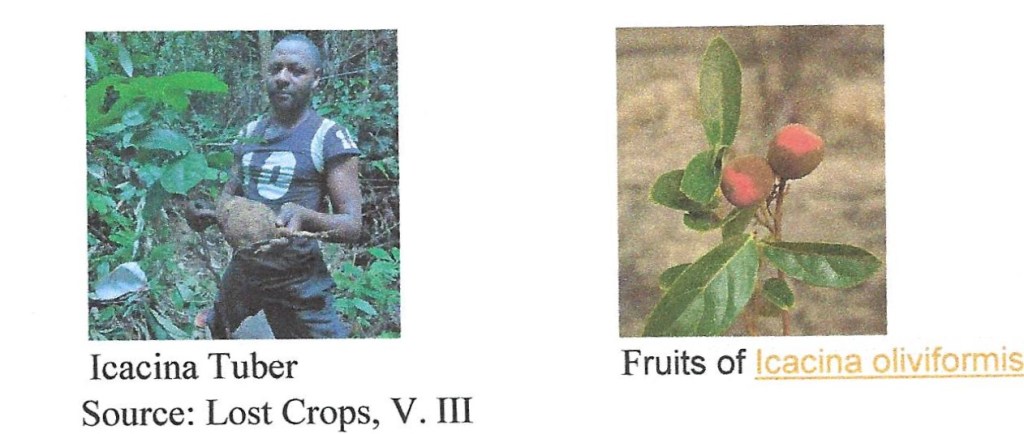
Like the yam bean, the icacina plant, a small drought-resistant shrub, yields 3 different types of food: fruits, seeds, tuberous roots what are consumed as snack, staple, and famine food. Though cultivated, the icacina plant is not fully domesticated; the bushes also grow in the bush.
Uses: fruit is eaten, seeds pounded into flour, and tubers used as flour which can make porridge. The giant tuber is such a great source of emergency moisture and food energy to the plant that it can survive at least four years without rain. (Lost Crops, V. III, p. 282). It can be used to treat constipation, food poisoning, hypertension, asthma, malaria, rheumatism, and toothache. It can also be used as an aphrodisiac and to induce emesis (vomiting) and abortion.3
Found in Senegal, Guinea, Northern Ghana, Benin, Gambia, Central African Republic, Nigeria, Chad, Congo, & parts of Sudan.
Tamarind
Tamarind Tree Pods
Tamarind is a massive, slow-growing, long-lived shade tree that produces a sweet-sour fruit which has multiple uses (See featured image above). The tree can grow up to 25 meters [82 feet] high. It has been called the tree of life because its sugar-rich fruits can be stored without refrigeration and safely served weeks or months later.
Uses: an ingredient of Worcestershire sauce, eaten as a fruit, and used to sweeten and season foods such as 1. Cereals, 2. Soups, sauces, curry, chutneys, and fish, 3. Confections, preserves, ice cream, and syrups, and 4. Drinks of many different kinds including carbonated drinks which rival coke in popularity. Parts of the tree is used as (1) fodder for animals, (2) fuel, and wood. It is also used as an ornamental tree because of its graceful foliage. (Lost Crops of Africa, V. III, pp. 149-153)
Long thought to have originated in India, but is actually of West African origin. Spread from western Sudan to Egypt and India and other parts of Asia.
References
1. Yambean.” National Research Council. 2006. Lost Crops of Africa: Volume II: Vegetables. Washington, DC: The National Academies Press. doi: 10.17226/11763.
2. ICACINA.” National Research Council. 2008. Lost Crops of Africa: Volume III: Fruits. Washington, DC: The National Academies Press. doi: 10.17226/11879.
3. Che CT, Zhao M, Guo B, Onakpa MM. Icacina trichantha, A Tropical Medicinal Plant. Nat Prod Commun. 2016 Jul; 11(7):1039-1042. PMID: 30452189; PMCID: PMC6552679.
Since real GDP (Gross Domestic Product) fell for the first two quarters of 2022, many in the media, the financial press, and politicians have concluded that the U. S. is in recession, stirring up a lot of debate and even controversy. This conclusion is based on the Rule of Thumb that two consecutive quarterly drops in real GDP constitutes a recession. This is called the 2 Quarter (2Q) rule. Please note that a rule of thumb is not a scientific law. Merriam-Webster dictionary defines rule of thumb as “a general principle regarded as roughly correct but not intended to be scientifically accurate.”
In 2011, I and a colleague (Dr. Marjorie Fox) published a paper in the International Journal of Business and Economics Perspectives entitled, “Is it a recession yet? The answer depends on who you ask”.
One of the main conclusions we came to was that “… the 2Q rule provides neither necessary nor sufficient conditions for pinpointing the start of a recession.”1 In other words, sometimes falling real GDP for two consecutive quarters does not indicate the beginning of a recession while sometimes a recession may begin without the GDP falling two quarters in a row. In the second and third quarters of 1947 real GDP fell by .6% and .3% respectively. Yet according to hindsight conclusions, no recession occurred. On the other hand, after GDP peaked in March of 2001, real GDP did not fall the next two quarters but the economy was deemed to have fallen into recession by the second quarter. Who determines when a recession begins and ends? Surprisingly it is not the government.
The Business Cycle Dating Committee of the National Bureau of Economic Research (NBER), a private research organization, is the entity that determines when a recession officially begins and ends. The Department of Commerce and other government entities accept their announcements as official. How does the NBER define a recession?
The NBER’s Business Cycle Dating Committee defines a recession as “a significant decline in economic activity spread across the economy, lasting more than a few months, normally visible in real GDP, real income, employment, industrial production, and wholesale-retail sales. A recession begins just after the economy reaches a peak of activity and ends as the economy reaches its trough. Between trough and peak, the economy is in an expansion. Expansion is the normal state of the economy; most recessions are brief and they have been rare in recent decades.”2 [Writer’s italics]. In short, the Business Cycle Dating Committee takes into account not just changes in real GDP but also changes in real income, employment, industrial production and wholesale-retail sales. If all of the aforementioned macroeconomic variables are falling over the two quarter decline in real GDP, the Committee would most likely deem the 2-quarter decline in real GDP to indicate a recession, as long as the overall decline is significant.
The preliminary estimates show that real GDP declined 1.6% and .9% in the first and second quarters of this year. These are not big numbers. Are they large enough to label the declines significant? We don’t know yet. When the estimates are revised, the final changes could go up or down. In terms of the featured graphic at the top of this post, are we in the pink recessionary phase of the Business Cycle or are we still hovering around the peak? Meanwhile employment is expanding. Is it a recession yet? My judgment is we don’t know but probably not.
Watch the Fed (the Federal Reserve). They are a good barometer. If the Fed thinks the economy is headed for recession or is in recession, they will be less aggressive in pushing up interest rates.
Fox, Marjorie and Frank Martin (2011). International Journal of Business and Economics Perspectives Volume 6, Number 1, Winter 2011
that Africa is an early center of plant domestication?
When I posted a piece on the black-eyed pea more than a year ago, around New Years, I promised my readers that I would do additional posts on Sub-Saharan Africa plant domestication. With a long delay, I am now fulfilling that promise. I felt a real urgency to get this post out, even though this is not the final product I envisioned. But I decided to not let the pursuit of perfection triumph over the good that could come from getting this post out.
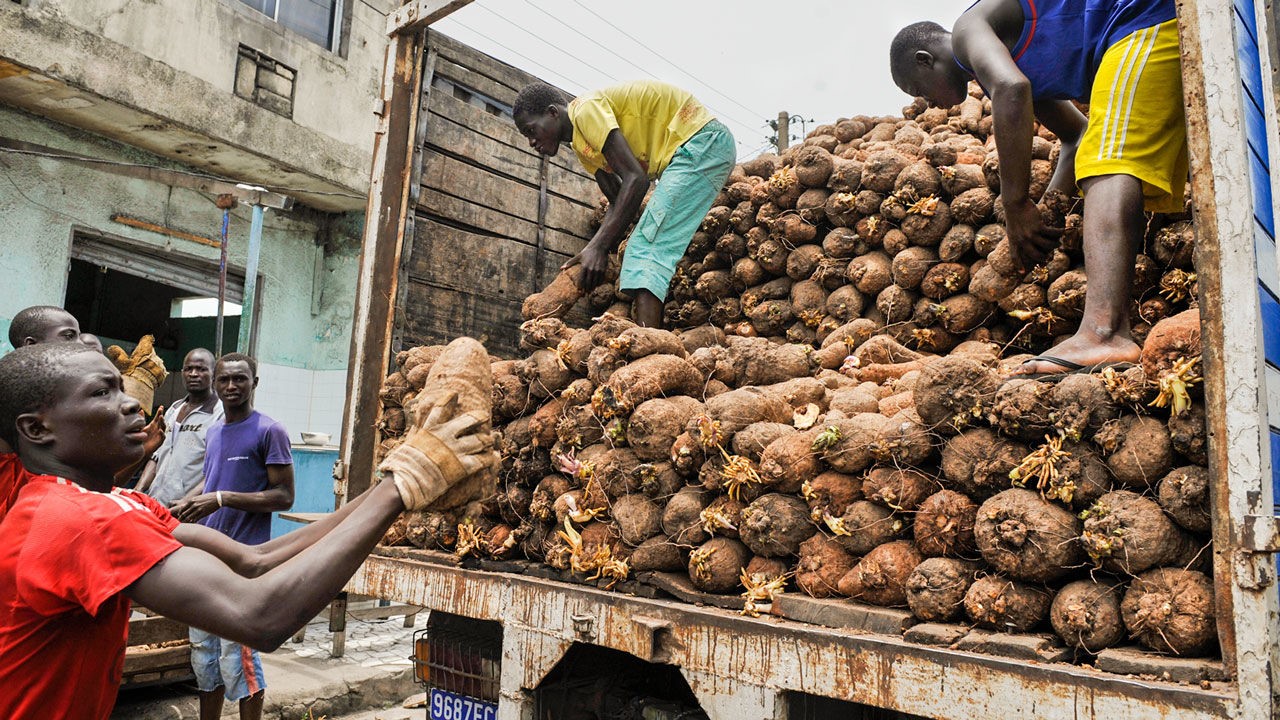
The featured image at the top of this post is a scene from Africa showing the transporting of the African yam, one of Africa’s early domesticated crops that is consumed throughout Sub-Sahara Africa. The yam is an important staple in the diets of Africans and Latin-Americans, a crop which is said to have been independently domesticated in both Sub-Sahara Africa and the Americas.
All the fruits and vegetables that we know and eat today came from wild varieties of these plants that were nurtured by humans to make them more productive and more amendable to human use and consumption. Plant domestication and human civilization are thought to go hand-in-hand. Agriculture gives rise to more stable and abundant sources of food than hunting and foraging, which in turn makes for larger and denser populations. When Europeans made contact with Africa via the Atlantic Ocean in the 1400’s (more than 600 years ago, before the Atlantic slave trade had started), they invariably took note of the dense populations they encountered. This could not have happened without an abundant food supply. Indeed, that coast of West Africa from Senegambia down to about Liberia was known as the Grain (or Rice) Coast because of the abundance of rice, millet, sorghum and cereal crops grown along that coastal area and inland.
Over the past several years as I searched the Internet looking for centers of plant domestication, I barely found any references that identified any areas in Africa as centers of early plant domestication; sometimes Ethiopia came up; I presume that the writers did not consider Ethiopia to be part of Black Africa. There were a few college course syllabi which acknowledged some centers of plant domestication in Sub-Sahara Africa. If you search diligently and long enough, you will find scholarly articles which acknowledge and provide scientifically based confirmation of Sub-Saharan African plant domestication.
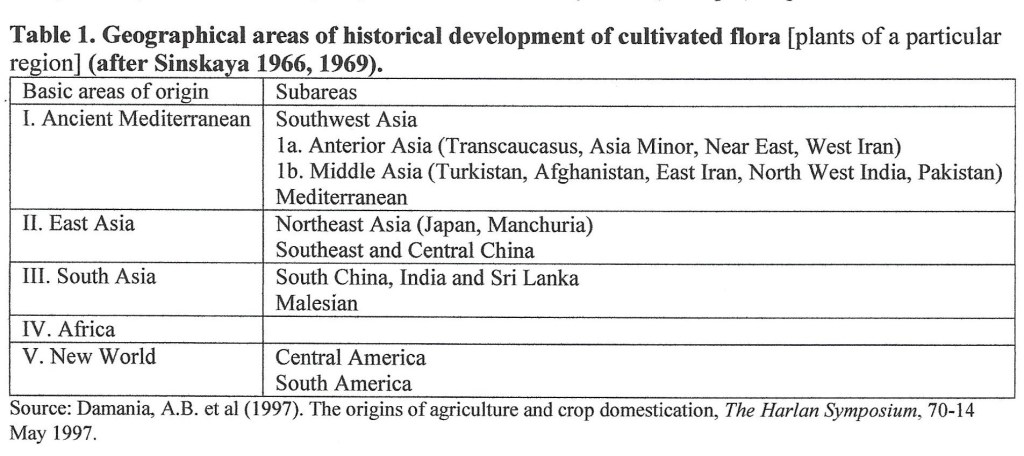
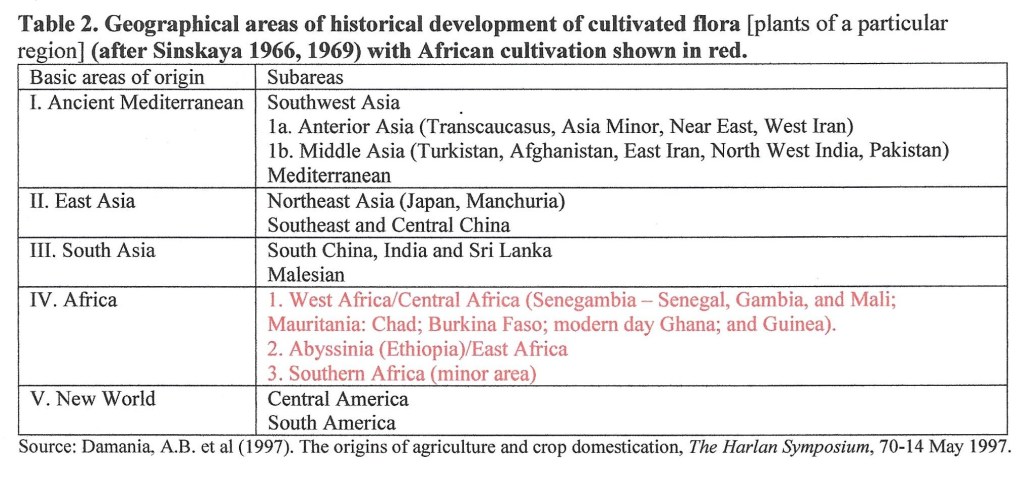
One of the first things I found right away when I began my search was an article(The origins of agriculture and crop domestication) which showed the world centers of agricultural domestication. As you can see below in the table taken from the article, the first column lists the basic areas of origin and the second column subareas. Note that for Africa, the second column is blank. In other words, according to these authors, Africa domesticated no plants. This is not true and at the time of the publication of this article (1997), most, if not all, of the information I will share was known. Elsewhere in the article, the authors list Abyssinian (Ethiopian) as one of the eight primary centers of domestication recognized by Vavilov, Russian botanist who did pioneering work in this area. Clearly the authors of this articles did not consider Abyssinia (Ethiopia) as part of Africa.
In this post, I will introduce you to more than fifty (50) plants that originated in Africa. More than forty (40) of them were domesticated by Africans. When most writers use the term Africa, they are actually referring to Sub-Sahara Africa, that part of Africa that is south of the Sahara, essentially Black Africa.
The West /Central African: domesticated plants are (a) African rice, cotton (Gossypium herbaceum), sorghum, pearl millet, Guinea millet, fonio, eggplant (Guinea squash), cow pea (black-eyed pea), long bean, sesame seed, icacina, bambara bean (earth pea or Bambara groundnut), geocarpa bean (groundnut), yam bean, Guinea yam, rizga, celosia, fluted pumpkin, bottle gourd (calabash), watermelon, cantaloupe, muskmelon, egusi, tamarind, yams, butterfruit, akee apple, red sorrel, tree grape (linnea oleosa), coleus (Kaffir potato), and amaranth. Undomesticated: (b) shea butter tree, balantes (desert date), oil palm tree, kola nut, locust bean, Tree grape (linnea acida), dika and chocolate berries..
Southern Africa domesticated plants: (a) horned melon and marula. Undomesticated: (b) marama, kei apple, Carissa, and tree grape (linnea discolor).
Africa-wide crops: (a) lablab (b) baobab tree
As you peruse the above lists, you will notice that the major area of crop domestication in Africa is West/Central Africa (with the vast majority in West Africa) to which is attributed the vast majority of the crops listed. The center of early crop domestication in West Africa was in present day Mali where the Niger makes a bend after emanating from the highlands of Guinea. The annual inundation of the river formed an inland delta (an alluvia plane) which created ideal conditions for growing certain crops, similar to what happened in Ancient Egypt as the Nile meandered from the Ethiopians highlands and emptied into the Mediterranean.
Most of the non-domesticated plants (the (b) plants) in the group of fifty-one mostly grow wild, that is they are not planted by humans, generally, but some are cultivated or protected because of their wonderful qualities that make them good for human consumption and for medicine, animal forage, and other things that people need or find useful, plants such as the shea butter tree and the baobab tree. A few of the plants included in this list as African domesticates, sesame seed and eggplant, for example, will be disputed by some experts; however, I do point you to some of the sources I consulted. It is a tentative list that could grow or diminish with the accumulation of more knowledge or a more exhaustive search/investigation. However, I believe it is more likely to grow rather than diminish in size.
When the blank cell for Africa is filled in, Table 1 becomes Table 2 as shown below:
I am sure that some of the African crops listed above, are unknown to many of you, crops such as, yambean, icacina, rizga, celosia, fluted pumpkin, egusi, akee apple, amaranth, balantes, dika, enset, tef, horned melon, marula, marama, and carissa. The names are exotic sounding but most of them have wonderful nutritional and/or medicinal properties. I will tell you something about these crops in my next blog post. But before I end this post, there are several observations I must make about African crops.
African Crops Exported to Asia and the Americas before Columbus
Several of Africa’s domesticated crops made their way to Asia during ancient times, namely, Kaffir potato (exported to India early on), pearl millet (exported to India in late third millennium B. C.), sorghum (exported to Ethiopia, India, China, and North Africa), cowpea – black-eyed pea (exported to India at a very early date), long bean (special form of the cowpea or black-eyed pea), watermelon (spread from Sudan to Egypt during the second millennium B. C. and also at a very early date to India), tamarind (spread from western Sudan to Egypt and India at an early date), CelosiaArgentea (exported to India and Indonesia), lablab (exported to Asia). calabash – bottle gourd (spread from western Sudan to Egypt and India before the second millennium B.C.), amarantha (Africa to Asia), and the sesame seed (also known as benne or benne seed) (exported to Mesopotamia and India). For years the cowpea, long bean, calabash; amarantha, and lablab were thought to be Asian exports to Africa when in fact it was the other way around; these plants were domesticated in Africa and transplanted from Africa to Asia. Two important sources for the aforementioned assertions are Murdock, Africa: Its peoples and its culture and Lost Crops of Africa, Vols. I and II.
Interesting observations about the black-eyed pea (also called a cowpea or long bean)
“In Asia there is a special vegetable, renown by growers for its productivity, by chefs for its appearance, and by diners for its flavor and tender-crisp texture. Reportedly, it is one of Southeast Asia’s top ten vegetables, grown especially in southern China and Taiwan. That report, however, does it less than justice. In addition, it is the most widely grown legume of the Philippines, where it is known as “poor-man’s meat.” It also is very well known in Indonesia, Thailand, Vietnam, Bangladesh, India, and more. … In Europe … it is being grown extensively. And the United States has also begun producing it on a large scale for Chinese, Thai, Filipino, Vietnamese, and Indian restaurants.”(Lost Crops of Africa, Vol. II).
“A surprising thing about this “Oriental” vegetable is that it is not from the East at all. In the beginning—thousands of years ago—it was unknown to any Asian, or for that matter any European or New World inhabitant. But it was well known to Africans. This historical fact is a fairly new realization. A century ago even botanists were fooled into labeling the plant Vignasinensis (bean of China). But now we know that it is nothing more than a very special form of cowpea, Vigna unguiculata—a plant that unquestionably arose out of tropical Africa thousands of years ago” (Lost Crops, Vol. II p. 223).
“On the basis of modern evidence, there is no doubt that the cultivated cowpea originated in central Africa from where it spread in early times through Egypt or Arabia to Asia and the Mediterranean. Fifty years ago the British botanist, Burkill, stated that the cowpea reached Sumeria about 2300 B.C. Perhaps that was the first leg of its journey away from Africa. In its new home across the seas, this wandering scion of cowpea took on the new guise of a long, long bean and began masquerading as an Asian food.” (Lost Crops, Vol. II, p. 232)
The way it has too often been presented, Africa is a debtor to the world when it comes to crop development and domestication. Though Africa has borrowed many crops from the rest of the world, she has in turn given much to the rest of the world when it comes to plant development and domestication.
Kay, Andrea U., et al (2019). Diversification, intensification and specialization: changing land use in Western Africa from 1800 BC to AD 1500, Journal of World Prehistory. Accessed at https://academic.oup.com/af/article/3/3/28/4638630
… that Africans came to the Americas before Columbus? – Part II
…that Africans came to the Americas before Columbus? – Part II
My last post was meant to whet your appetite by dropping a few ironic gems such as my storing in memory the photo of a black Aztec dancer from my high school Spanish book in San Bernardino and my being president of a high school Spanish honor society called Quetzalcoatl, an important Aztec-Mexican god. In the next couple of posts, I will give more detail and explanations of the African contacts with Ancient Americans over a period of some 3,000 years.
I realize that these assertions about the presence of Black Africans in pre-Columbian America may seem, to many, if not most, to be “fantastic” romanticizing or speculation on the part of the advocates of these assertions. Therefore, I find it necessary to lay out very clearly the logic of and evidence for these “fantastic” assertions. I need to remind the reader of the obstacles to fairly judging or assessing this issue. The obstacle is a type of “genteel” racism that is a legacy of slavery; this racism is found in the most unlikely of places, our academic institutions. It is the paternalistic type of racism espoused by those who, on the surface, appear to be friends of Black People but who, in actuality, view Black People as not having the ability to measure up to other races. It is not red-neck racism but a type of racism that views Black People as hapless, weak victims who have never been able to compete with the superior white and yellow races. Do they come right out and say this? No. But read between the lines.
This is a legacy of slavery that caused African Black People* to be viewed as somehow inferior to whites and, therefore, enslaving them was a net benefit in exposing them to white civilization, thereby assuaging the guilty conscience of the slave owners and a country which allowed slavery. Before the advent of modern slavery, this was probably not the view held by most Europeans. What I am saying is that racism did not bring about slavery but that slavery brought about racism§. When such thinking has become unconsciously embedded in the mind, it dictates what the mind will and will not allow. Anything that contradicts this unstated axiom will be thrown out.
In light of the above considerations, three tasks are before us:
Establish that Black Africans were in America going back some 3,000 years.
Demonstrate how these Africans impacted the culture of Ancient America in significant ways, not as subservient individuals but as rulers and/or individuals of high position.
Establish how the Africans got here.
None of what is said in this post is meant to denigrate the wonderful achievements of the Ancient Mexicans and other Ancient Americans who built marvelous civilizations. It is to say that at certain points, they were helped along or impacted by Africans over a long period of time. This does not diminish the achievements of Ancient Americans no more than acknowledging that the Greek alphabet is derived from the Phoenician alphabet which as derived from Egyptian hieroglyphs diminishes the great and wonderful achievements of Europeans. Indeed, practically all modern writing systems, with possible exception of the Chinese writing systems, ultimately go back to the Egyptian hieroglyphs. Yet this great modern civilization of the Western world is an achievement the Europeans can rightly be proud of. You cannot separate the civilization from the genius of the Europeans, notwithstanding the outside contributions.
Proof of African Presence in Pre-Columbian America
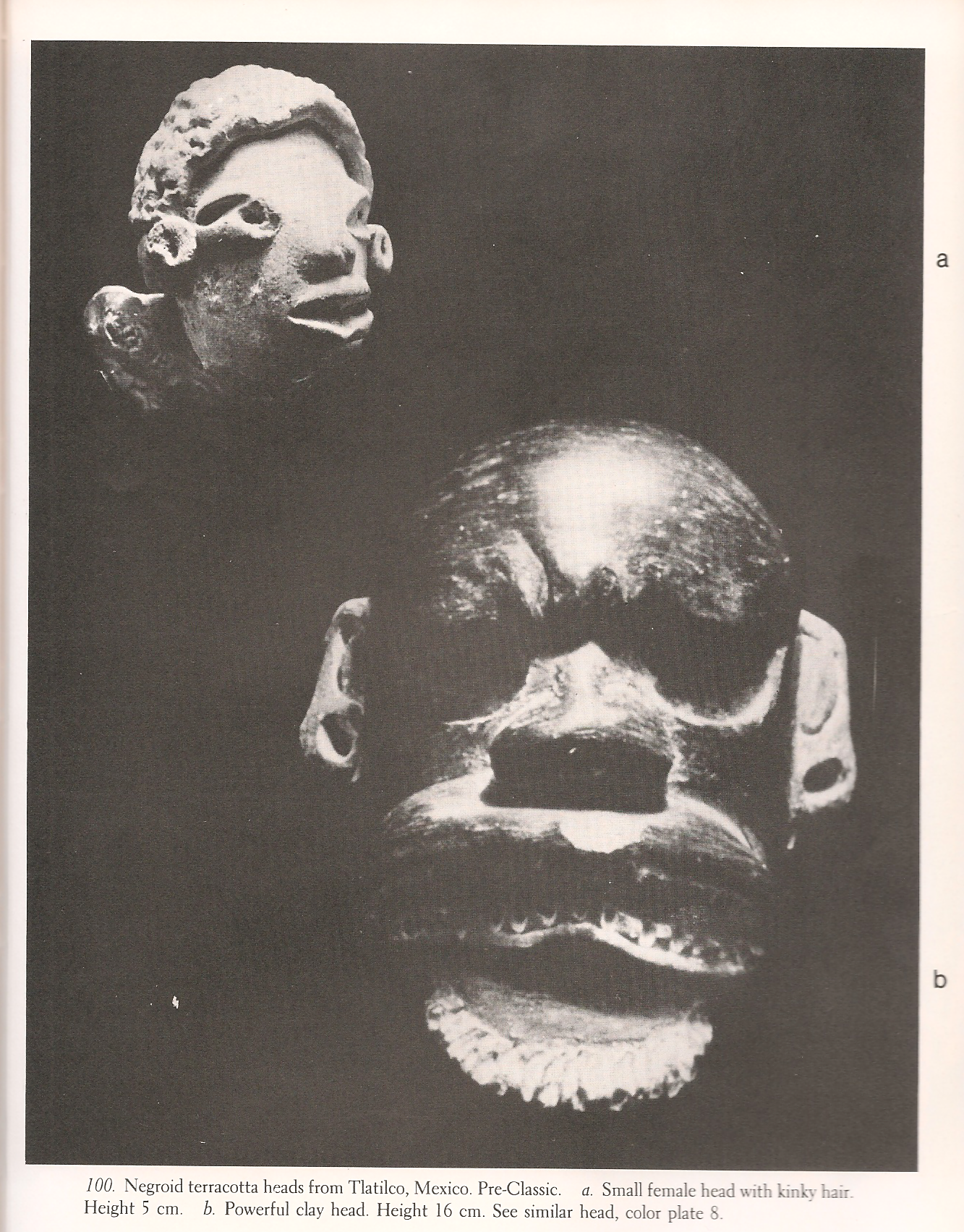
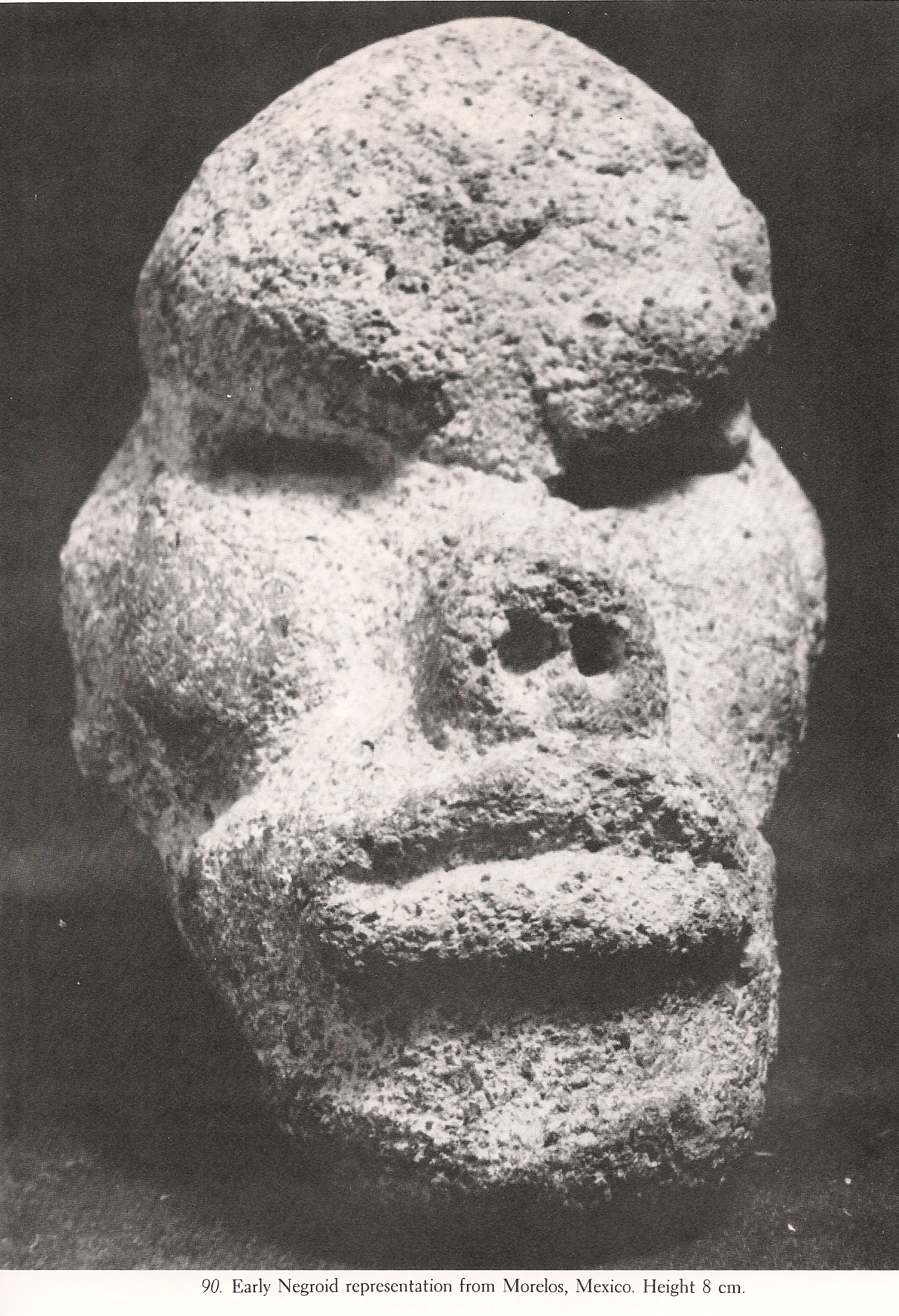
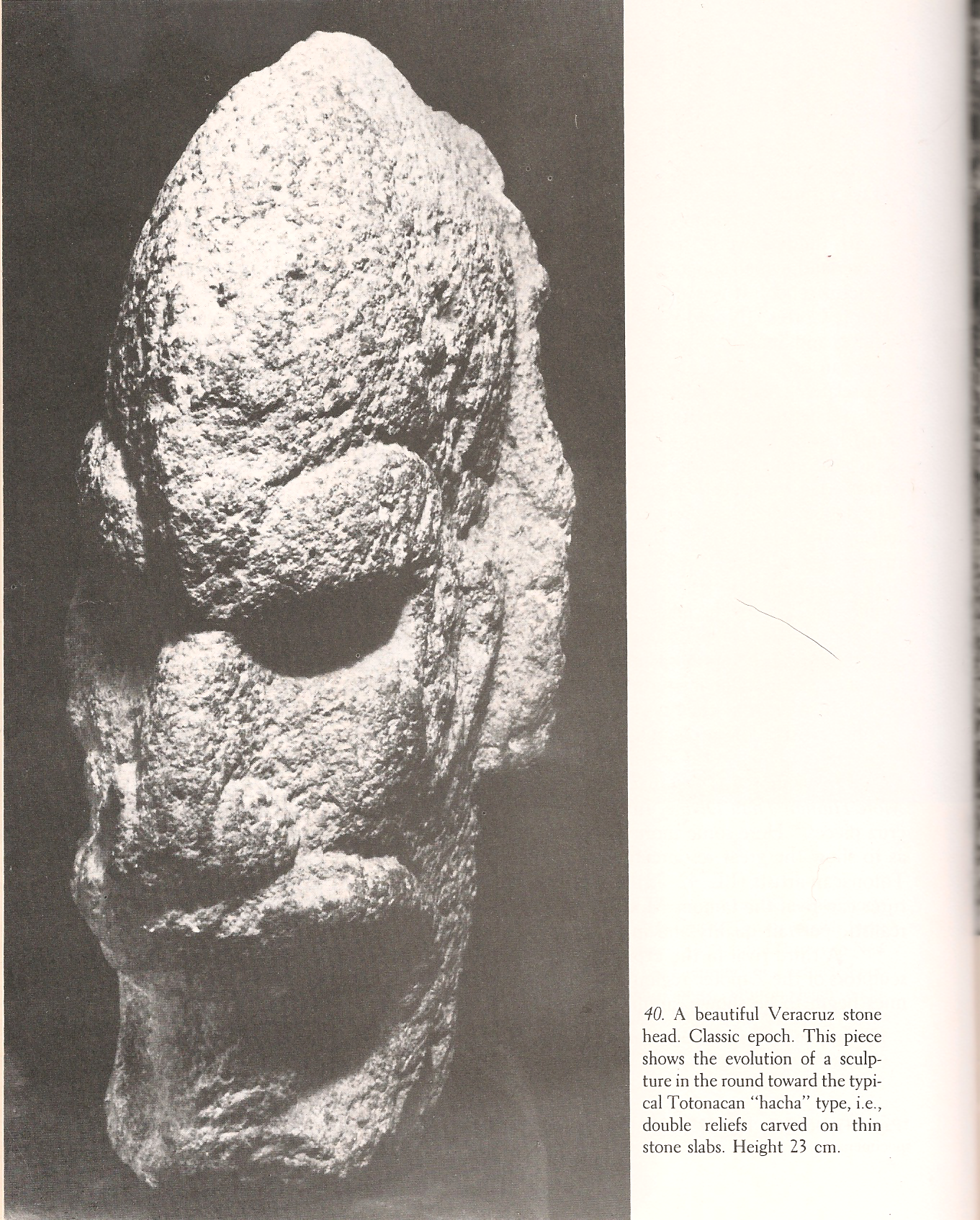
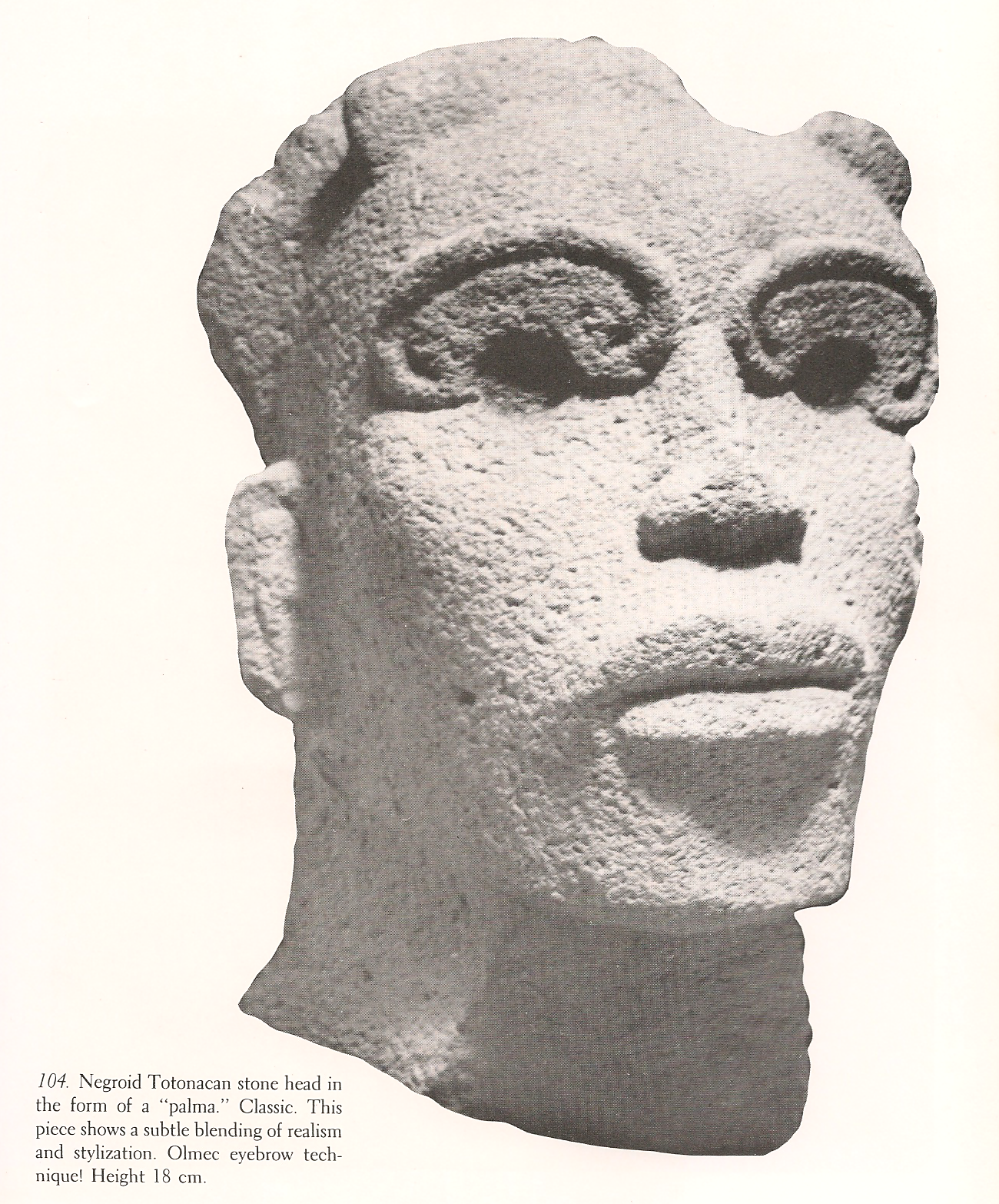
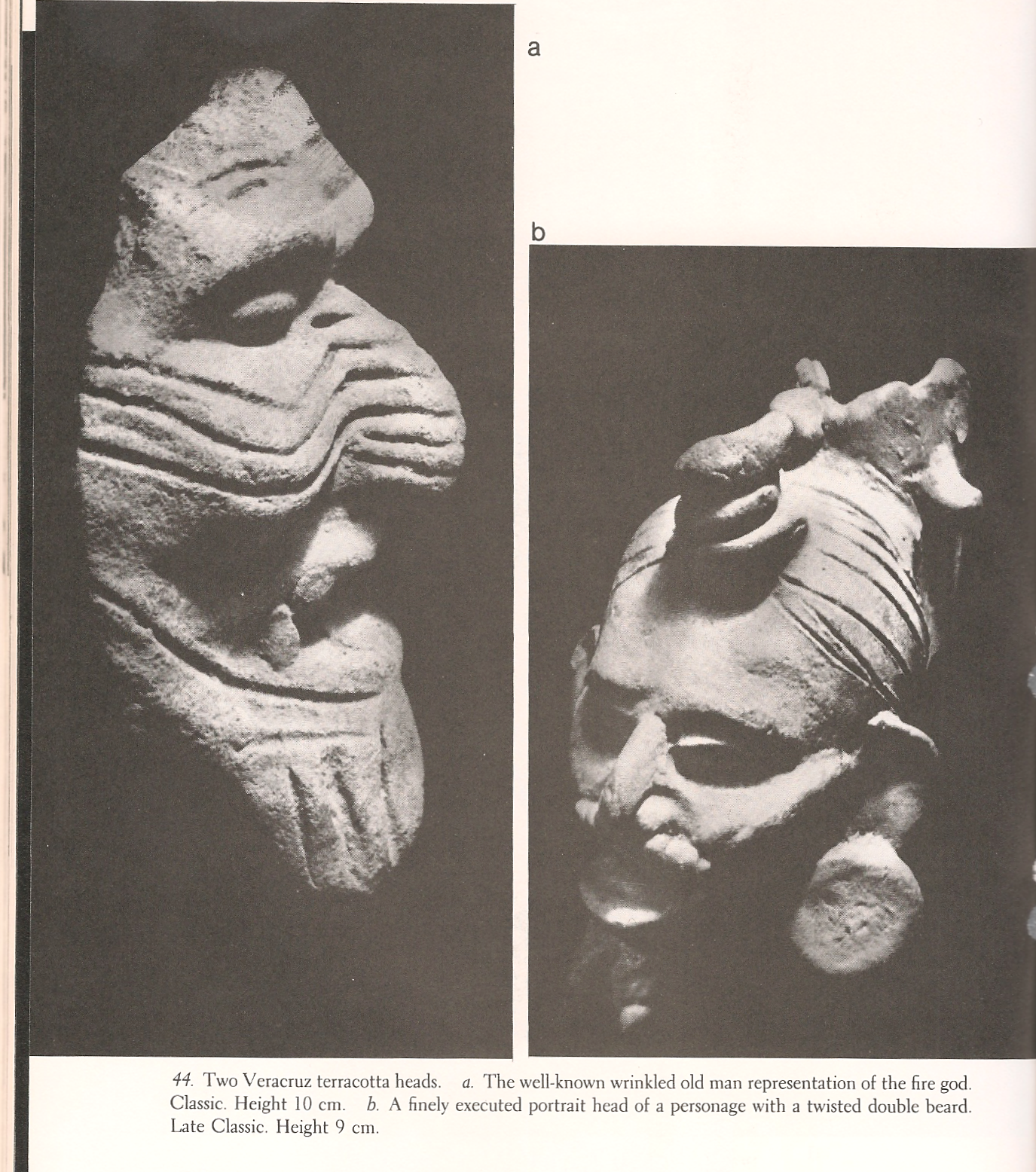
The most compelling proof of the African presence in Ancient America is found in the representations of Ancient American artists. This essay and the other essays that follow draw heavily upon the work of the late historian Ivan Van Sertima and the German Art Historian turned archaeologist, Alexander von Wuthenau. When viewing the Ancient American representations of Africans, keep in mind the admonition of von Wuthenau speaking about how the Ancient American artists saw things, “…they possessed and still possess two remarkable abilities. To begin with they can see without looking; and what they see they do see, and nobody can tell them that they did not see what they did see.”1Von Wuthenau found it necessary to issue this admonition because he saw how expert Americanists (those who study the culture and history of the Americas) more often than not refuse to acknowledge what their eyes see. To illustrate this point, von Wuthenau recalls a young graduate student saying, after he had looked at photographs for his book, “They look like Negroes but they aren’t.” Wuthenau comments that his thinking was the “result of university training.”2 Von Wuthenau did not argue with the young man.
Though there is ample proof of the pre-Columbian African presence throughout the Americas, this essay concentrates on the heartland of early Mexican civilization which encompasses the Southeastern Mexican states of Vera Cruz, Tabasco, Puebla, Mexico, and Oaxaca. The states of Guerrero, Chiapas, and Campeche also come into play.
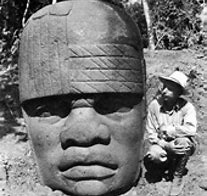
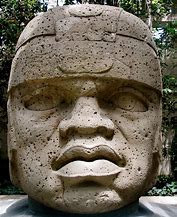
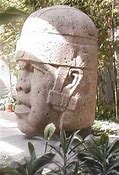
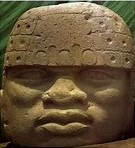
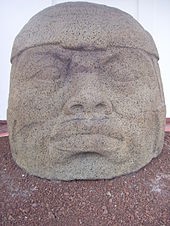
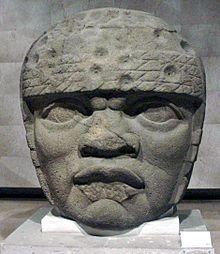
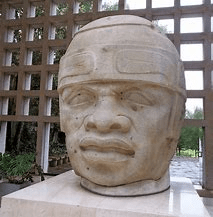
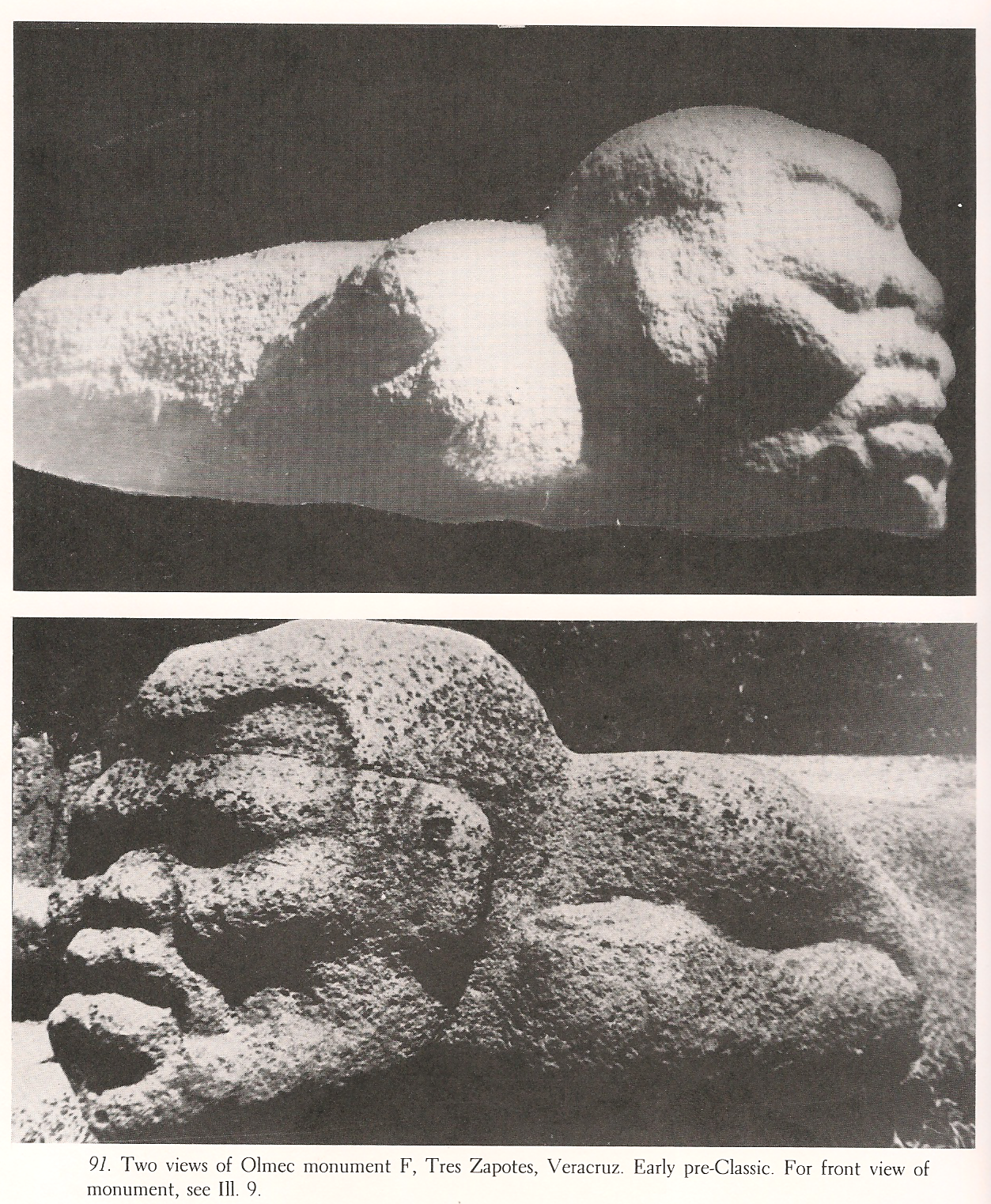
Let us now view one of the types of evidence the Ancient Mexican artists left us, the huge stone heads found at San Lorenzo, Tres Zapotes, and La Venta which are located in the Mexican states of Veracruz and Tabasco. One of the large heads from San Lorenzo is shown as the Featured Image of this post. View below photographs of several other huge Olmec heads. Altogether, seventeen of these huge heads have been found, 10 at San Lorenzo, 4 at La Venta, 2 at Tres Zapotes, and 1 at Lacobata.They range in height from 5 to 11 feet and weigh between 6 and 50 tons. All but 4 were found in the state of Veracruz.3 They go back approximately 2,500 years ago, having been estimated as being made between 800 B.C. and 600 B.C.4 These heads are not simply stylized productions; each one is different facially and each may be considered to be a portrait of a living individual. Also their helmets are different. An unbiased observer would conclude that these faces are Negroid, without hesitation.
Many, if not most, historians and archaeologists either do not talk about the racial/ethnic identity of the heads or deny that they are African. Those who touch on the racial aspect of the heads will say the physical features are common to people who live in the areas where the heads were found. If these features are common to the people still living in the areas, perhaps it is because they carry the genes of those ancient Africans. Consistent with the aforementioned suggestion is the fact that the Afro-Mexican population of 1.8 million tends to be concentrated in the states of Veracruz, Oaxaca, and Guerrero where most of the heads were found.5 Some have labelled these heads as accidental creations of the artists. I guess you could call this the “Oops Theory”!6
Though some question what they see, there seems to be pretty much agreement that the individuals sculptured were rulers. However, starting with José Melgar y Serrano, who first brought these colossal heads to the world’s attention, many authoritative scholars have acknowledged the “Africanness” of the heads. Melgar described them as Ethiopian (meaning African, not Abyssinian) in appearance in the 1870’s. Wuthenau described Melgar’s reaction this way: “Melgar’s mind, not yet tainted by certain currents of modern (and perhaps not so modern) anthropology, reacted quite normally to this newly found evidence of black man’s presence in Ancient America.”7
Von Wuthenau gives a summary of the evidence in the following words: “…the startling fact is that in all parts of Mexico, from Campeche in the east to the south coast of Guerrero, and from Chiapas, next to the Guatemalan border, to the Panuco River in the Huastecas region (north of Veracruz), archaeological pieces representing Negro or Negroid people have been found, especially in archaic or pre-Classic sites. This also holds true for large sections of Mesoamerica and far into South America – Panama, Colombia, Ecuador and Peru.”8The pre-Classic period is before Olmec culture was fully developed, before it had fully come into its own. In short, the Africans were there at the beginning of Olmec civilization.
Based on illustrations in his book, von Wuthenau concluded that “the finest sculptural efforts of San Lorenzo came first, with not the slightest indication of an artistic evolution leading up to the masterpieces. The implications of the second fact are prodigious. Several distinguished Negro personages and at least one, or several, first-rate artists, complete with well-developed stone sculpture techniques, appeared, so to speak, out of the blue on the American continent 3,000 years ago! Up to now absolutely no reasonable explanation has been given by any scientific professional for this startling event”9. To my knowledge, that is pretty much where the state-of-knowledge stands now.
Further developing von Wuthenau’s statement, how can we determine what the Africans found upon arrival and what did they bring with them? To answer that question, we now turn to Van Sertima who developed the following guidelines for determining what is a loan and what is native.
Be time-specific and culture-specific.
Cite evidence, where possible, of a long evolution of the habit, artifact, system or technique, in the area of the donor.
Demonstrate a lack of known antecedents in the area of the recipient.
Consider levels of identity in complexity as against superficial stylistic similarity,
Think not in terms of single traits but of complexes or clusters of interlocking parallels.10
Van Sertima applies his guidelines to come to a position on whether the Egypto-Nubians (the Black Africans represented by the colossal heads) brought the knowledge of pyramid building to Mexico, with the following observations.
There was a very long history of pyramid building in Egypt, Nubia (Cush), and Western Asia (Babylon) but there were no pyramids in America before the “contact period” (800-680 B.C.).
“The first American pyramids appear at La Venta along with the colossal Negroid heads. Suddenly in the “contact period” the Ziggurat or stepped temple (a particular kind of Babylonian/Egyptian pyramid) begins to appear in America, and not only is the design identical but, like its presumed prototype, it is sun-star oriented and encircled by a precinct [fenced enclosure]. Not only are the shape and religious functions the same but also the astronomical and spatial relationships.”11
During the period under consideration, the Nubians (Cushites) were still building stepped pyramids.
Based on numerous considerations, Van Sertima hypothesizes that the Egypto-Nubians who landed on the Gulf were sailing on Phoenician vessels in search of metals when they got caught up in currents that caused them to drift into the Gulf of Mexico, eventually ending up in Mexico. The Phoenicians were the merchant Marines of the Egyptians who for centuries maintained close ties with Phoenicians who at times were essentially a colony or vassal state of Egypt. This is plausible because the Ancient American artists created a statue of a Semite alongside the colossal Negroid heads and who appears to be Phoenician based on his dress, something there seems to be pretty much agreement on. The “contact period” postulated by Van Sertima falls within the 100-year period of the 25th Dynasty, the last Cushite dynasty to rule Egypt, and fits with the carbon-dating of the heads and the pyramids. Additionally it is almost certain that Semites from Western Asia and Japanese drifters made contact at numerous times with the Americas and Mexico in particular, centuries before Columbus.
Von Wuthenau and Van Sertima are generally in agreement except for the contact period. Von Wuthenau accepts R. A. Jairazbhoy’s thesis that the “the Olmecs were transatlantic emigrants from Egypt who had been sent on an Expedition by Rameses III”.12 Jairazbhoy puts the date of the expedition at around 1187 B.C. Van Sertima rejects that date because it is too early relative to when the colossal heads and the first pyramids were built. Furthermore, he points out that the Egyptians had stopped building stepped pyramids, or pyramids period, centuries before but the Nubians were still building them.
It is right and proper that I should end this post with the words of a Mexicanscholar and investigator, Alfonso Medellin Zanil, who as Director of the Archaeological Museum of the State of Veracruz in Jalapa, said,
“Kinky hair, broad chubby noses, thick lips and other less definable corporal features, belong to the ethnic group of Negroes, alien to Amerindian man. It is possible that at the end of the pre-Classic a small group of Negroes arrived on the Atlantic shores of America, though they could not perpetuate their biological inheritance, on account of their small numbers. Memory, legend and myth would surely deify them or endow them with the character of cultural heroes depicted in terracotta figurines and who were immortalized in monumental stone sculptures”.13
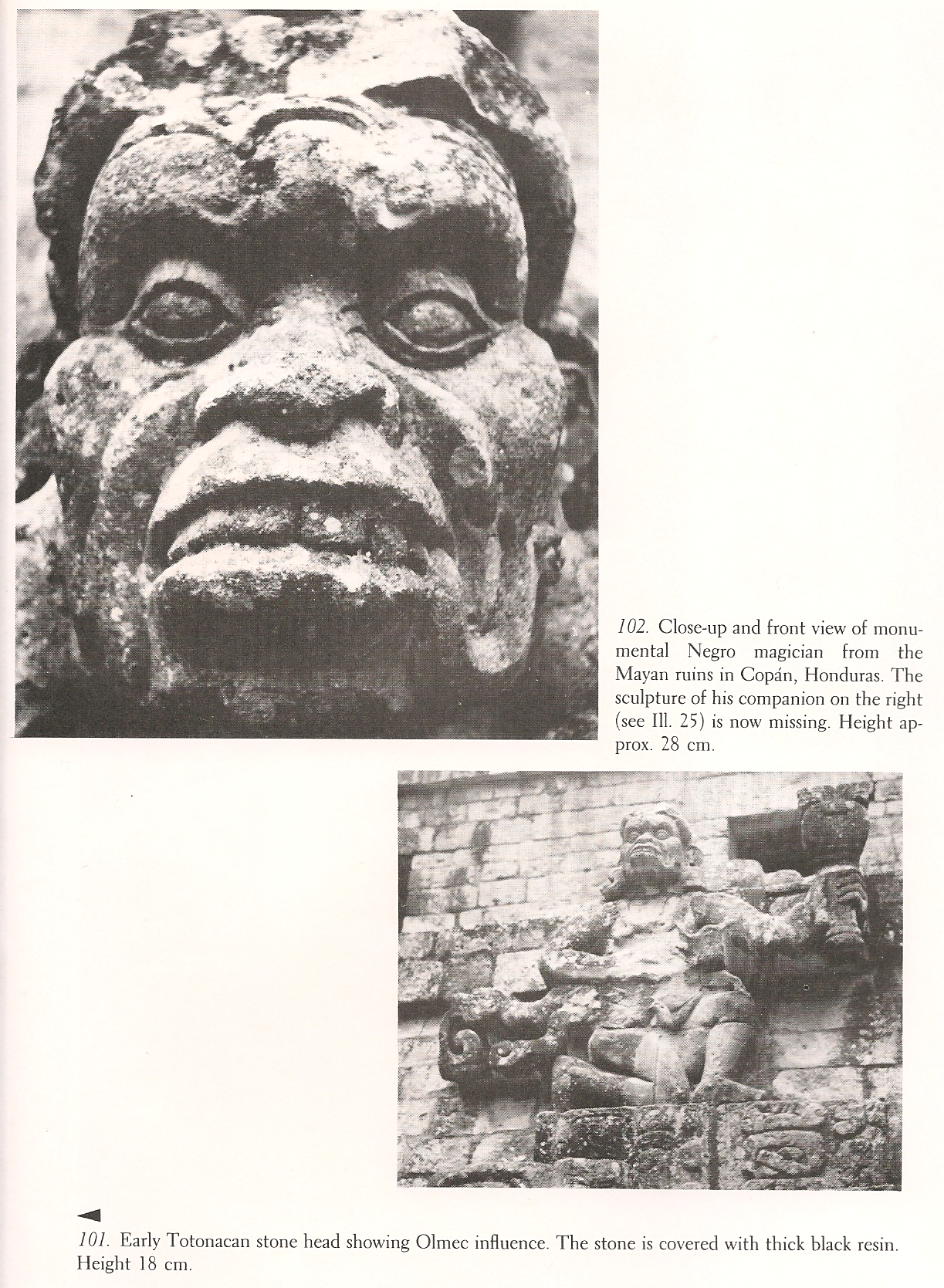
In other words, the physical characteristics of the individuals shown below (broad chubby noses and thick lips. We cannot see their kinky hair because it’s covered up) are alien to the Ancient Native American (the Amerindian). The numbers may have been more significant than he thinks.
Can we drop the mike?
Notes
*I specify “African Black People” because Black People from Asia and the Pacific (Papuans (New Guineans)), Native Australians, Fijians, and other Melanesian people) are viewed somewhat differently. For instance, the Mormon Church doctrine that Black People could not be part of the Mormon Priesthood (which they changed recently) applied only to African Blacks, not to Fijians and other black Melanesians.
§Interestingly during the first half of the 1600’s, before the institution of slavery became entrenched in the English colonies in America, black indentured servants interacted with white indentured servants on the basis of equality as evidenced by black-white unions and marriages not being proscribed. This would change during the latter half of the 1600’s as chattel slavery became entrenched and legalized.
References & Citations
Von Wutheran, Alexander (1975). Unexpected faces in Ancient America: The historical testimony of Pre-Columbian artist (1500 B. C. – 1500 A. D.), p. xiv
There are 7 different faces here. The helmets they are wearing are Egyptian.
Found at San Lorenzo, VeracruzFound at La Venta,TabascoFound at San Lorenzo, VeracruzSide View of Previous PhotoFound at San Lorenzo, VeracruzFound at Tres Zapotes, VeracruzFound at San Lorenzo, VeracruzFound at San Lorenzo, Vera Cruz
that Haitians fought alongside American Patriots in our War for Independence?
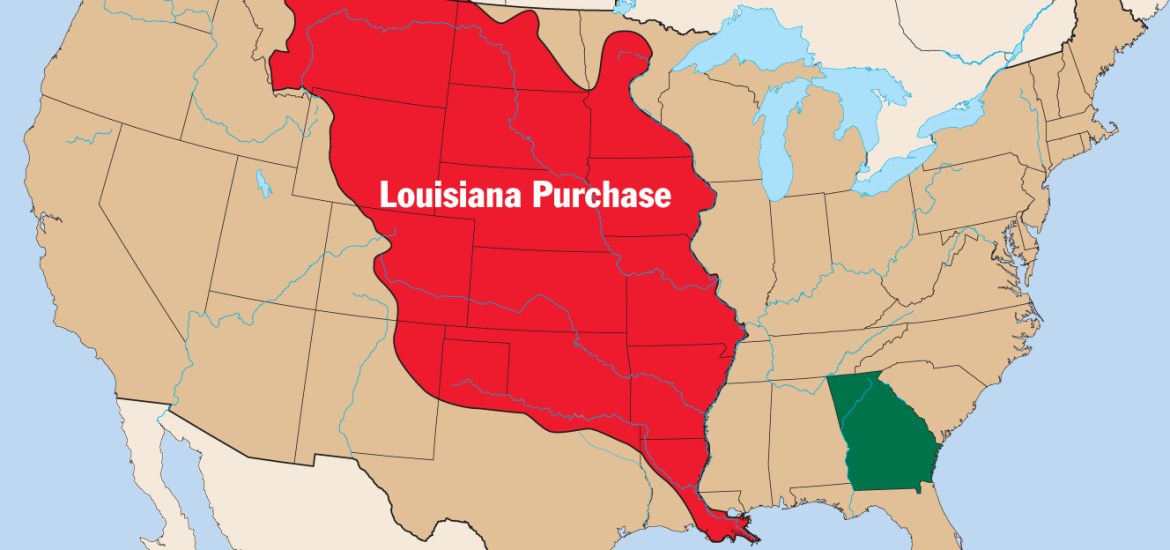
It gives me cause to pause in seeing the U. S. Customs and Border Protection Services drop the heavy hammer on the Haitians, somewhere in the neighborhood of 14,000 under a bridge in Del Rio, Texas at the U. S.-Mexican border, trying to get into the United States. Homeland Security has quickly and significantly increased the number of agents and resources to the area of Del Rio. Some of he Haitians are being flown back to Haiti.1 I could not help but think back on the fact that at two critical points in the history of the United States, actions undertaken by Haitians had an influence, and a positive one, on the destiny of our country. In the years from 1776 to 1781, Haitians helped the American colonists gain independence from Great Britain by fighting with the colonists in the Revolutionary War, and two decades later, their defeating the French in their War for Independence from France was an important factor in influencing the French decision to sell the Louisiana Territory to the United States in 1803, an action that doubled the size of the United States.
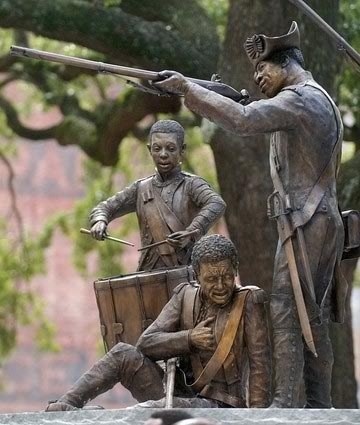
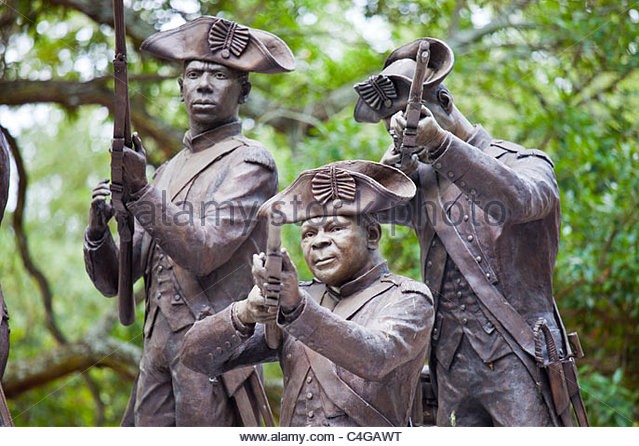
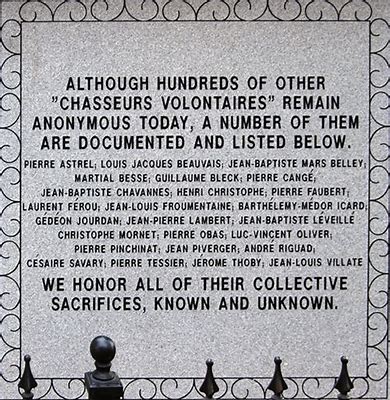
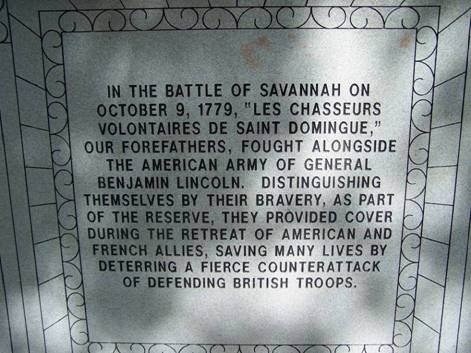
Haitians came to assist the Americans in their fight for independence, even though they had not yet achieved their independence from France, in 1779. They were free people of color (called des gens de couleurs libres) organized into a regiment called Chasseurs-Volontaires de Saint-Domingue and eight hundred (800) volunteered to serve under the command of a French officer, First Lieutenant Count d’Estaing. They fought valiantly in the Battle of Savannah. Their bravery was memorialized by a statue erected by the city of Savannah in 2007.Photos of the monument and memorial inscriptions are shown at the end of the post2. In my unpublished book, I referenced the actions of these Haitians as one of the examples of people of African descent playing a role in the formation of the American Republic, contrary to the assertions of Supreme Court Justice Roger Taney in the Dred Scott case. In addition to those 800 Haitians of African descent, five thousand (5,000) Americans of African descent fought in the Revolutionary War on the side of the Patriots. If fighting in the Revolutionary War that resulted in independence and the subsequent birth of the nation with the adaption of the Constitution does not qualify one as having a hand in establishing the nation and the Constitution, then nothing does.
The Haitians3 threw a monkey wrench in the designs of the French for empire in the Americas by defeating them in long drawn out wars from 1791 to end of 1803. The situation in Haiti over these twelve years was complicated, bloody, and just horrific, involving more than just France and revolting slaves and free people of color but British and Polish as well. In the beginning, the revolts of the Haitians were aimed at ending slavery within the French Empire leading to Civil War against white slave owners but ended up with the Haitians fighting for independence from France. That independence was achieved with the defeat of the French Army at the Battle of Vertieres on November 18, 1803. Between yellow fever and military casualties, total French deaths have been estimated at 40,000. With these losses coupled with the costs of wars in Europe, Napoleon was willing to get rid of the Louisiana Territory for $15,000,000. He undoubtedly needed the cash! The desire to acquire the Port of New Orleans was one of the main reasons why Jefferson was willing to, in a sense, go against his own advice to acquire this territory which at the time doubled the size of the United States of America.
The hell that the Haitians dished out to the French was surely one of the factors making this possible. A British Army officer, visiting Saint-Domingue, after observing the training of Haitian soldiers wrote, “At a whistle, a whole brigade ran three or four hundred yards, and then, separating, threw themselves flat on the ground, changing to their backs and sides, and all the time keeping up a strong fire until recalled…This movement is executed with such facility and precision as totally to prevent cavalry from charging them in bushy and hilly country”.4 This is just an indication of what the French were up against.
Some of the Haitian heroes at the center of these revolts and wars were Toussaint L’Ouverture, Jean-Jacque Dessalines, and Henri Christophe. Probably the most famous of the three is L’Ouverture who, in 1802, put his army under control of the French Army after they had made promises which they did not keep. The French apprehended him, sent him off to France where he died in jail. Needless to say, that did not stop the revolution as the French were decisively defeated in November of 1803.
Though I refer to the country as Haiti, it was called Saint-Domingue until the name was changed to Haiti on January 1, 1803 when independence was declared.
This short essay was first posted the morning of the assault on the capital but before the assault occurred. I think we need to keep in mind the things I pointed out in that post.
Trust in Our System of Government
By the end of today (January 6, 2021) or by tomorrow, I expect that the U. S. Congress will have accepted the Electoral College votes for President, and Joe Biden will be the duly elected President of the United States after his Inauguration. Like it or not, on January 20, Joe Biden will be my President, regardless to how I feel about his policies and political/philosophical outlook.
Our process for electing President was followed. The concerns about how the voting processes were implemented at the state and local levels are real and serious but did not change the process for selecting our President. Furthermore, in line with our constitutional system of governance, how voting is conducted is left to the various states, very purposefully. The founders were careful to set up a system of separation of powers to avoid tyranny being imposed from above or by certain powerful interests aimed at thwarting the “Will of the People”.
Some of the practices and actions taken by some states and localities in the 2020 election were at least questionable. However, that is an issue of human imperfection, not an indictment of our system of governance but an indictment of human nature. We thread a thin line in attempting to deal with the partisan actions of those seeking advantage for their side.
Our system is designed to give voice to the unimportant as well as the important, to the minority as well as the majority. Rhode Island has a thumbnail full of people in comparison to California; yet in the Senate the few people of Rhode have the same representation as the many people of California. In selecting the president, and in the makeup of the House of Representatives, large states are given more power than small states since the number of Electoral College votes is based on their population. Yet in this system, Rhode Island’s electoral votes count.
We must acknowledge the fact that we have a good, though not perfect, system run by imperfect people. We were reminded by a Founding Father that for our system of governance to work properly we need a moral people.
The challenges to the election results leading up to the debates taking place in Congress today are right and in order. It’s a bit over the top to say or imply that these debates and challenges are somehow an attack on our democratic institutions. Our whole system came into existence through such debates and challenges. We must thoroughly examine what happened and, to the extent possible, take corrective actions to effectively address the problems so that we may become a more perfect union.
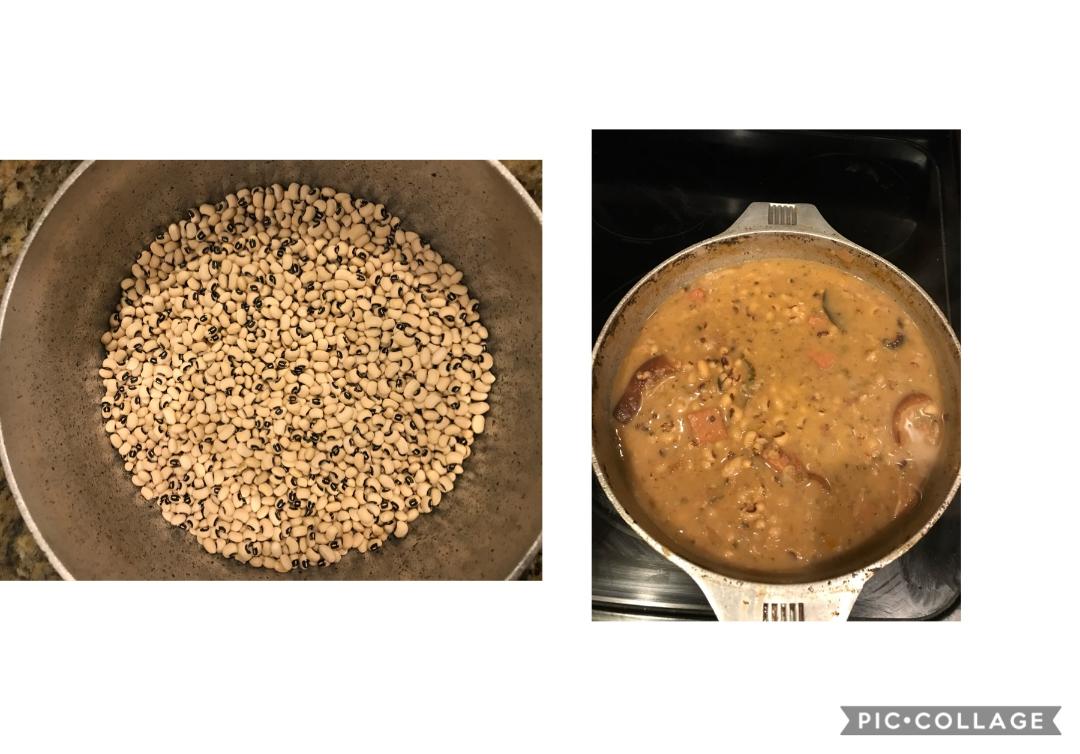
It is a tradition of millions of Americans all over the country to cook black-eyed peas and cabbage for New Years. The featured image above shows dry, uncooked black-eyed peas on the left and the cooked peas, a la New Orleans, on the right. This pea is one of the many African-domesticated plants and cultigens that have migrated from Africa to Asia, Europe, and the Americas, usually by means of human transport instead of ocean drift. Indeed, for years it was erroneously assumed that cultivated plants and vegetables common to Africa and Asia, and India especially, before the historical period had been domesticated in Asia. Recently some of these errors have been corrected.
Though many plants have been domesticated all over the African continent, the main center of African plant domestication seems to have occurred in West Africa in an area centered around the bend of the Niger River in the modern country of Mali (a part of ancient Mali and ancient Ghana before that). The Niger River has its source in the Highlands of Guinea from which it flows to the northeast through Mali where it changes directions and begins to flow southeast traversing through the counties of Niger, Nigeria, and Benin where it empties into the Atlantic Ocean. The bend, or the crescent that it forms, is in Mali. The people who live in this area are the well-built, highly regarded Mandingo people, who are part of a larger group of people called the Mende who made up most of the captured Amistad Africans from Sierra Leone.
Like several other African domesticated plants which passed from Africa to India, China, and other parts of Asia, plants such as pearl millet, sorghum, Bambara bean, celosia, amarantha (a type of hotherb or green), and lablab (whose pods, seeds, and leaves are used for environmental protection and forage), the black-eyed pea (called a cow pea), long thought to have originated in Asia because it was found in both places, is now universally acknowledged as of African origin, probably Central Africa. The Chinese long bean, a special form of the cowpea or black-eyed pea, was long thought to be of Chinese origin but “A surprising thing about this “Oriental” vegetable is that it is not from the East at all. In the beginning—thousands of years ago—it was unknown to any Asian, or for that matter any European or New World inhabitant. But it was well known to Africans. This historical fact is a fairly new realization. A century ago even botanists were fooled into labeling the plant Vignasinensis (bean of China). (Lost Crops of Africa, Vol. 2, p. 223).
Plant domestication is important because it is associated with the advance of civilization and the formation of dense populations due to the more reliable and abundant food supply made possible by humans deliberately growing and improving wild plants rather than just depending on hunting, fishing, and foraging. During the Middle Ages, Arab and European travelers to Sub-Sahara Africa, especially West Africa, encountered centers of dense populations associated with well managed and well laid out cities. It did not take Europeans long to realize that they had found the labor power they sought for New World development, large numbers of people who were agriculturists for the most part. With willing cooperation from African leaders and rulers, the dense populations were greatly diminished over several centuries.
Like other legumes, the cowpea (black-eyed pea) provides an impressive array of benefits to the human consumer. Its seeds “famously deliver the amino acids needed to grow or repair protein-based tissues such as brain, nerve, and muscle, as well as to construct the enzymes and proteinaceous hormones necessary for normal life functions. As tools for balancing nutrition they can have a powerful overall effect among the impoverished masses. By providing protein (not to mention vitamins, minerals, and energy), they make main foods—notably, the bulky staples, such as rice, maize, cassava—work better in the body. In this sense, they help increase the bioavailability of other nutrients. Grain legumes, in other words, act like nutritional cogwheels, making everything else go round and round in proper order.” (Lost Crops of Africa, Vol. II). Since it thrives in many types of soil, the cowpea is the most widely planted native legume in Sub-Sahara Africa. The fact that grain legumes such as red beans and black-eyed peas make staples such as rice work better in the body may be the reason why people in the New Orleans area, and the Gulf South generally, always eat rice with their beans, an alien practice to me since I hail from the northern Mississippi Delta where beans are eaten with corn bread only.
I will be posting more about ancient African plant domestication in future posts. Some of you will be surprised to hear about some other common food plants that were first cultivated in Sub-Sahara Africa. Though the internet is replete with information on this important topic, I found Murdock’s Africa: Its peoples and its culture and the NRC’s Lost crops of Africa, Vols. I, II, and III to be must reading for one interested in this topic.
… that Hollywood has no regard for historical accuracy in putting blacks in historical roles?
One of the practices of Hollywood that gets me hot under the collar is having black people play historical characters that were almost certainly white and white people play historical characters that were almost certainly black. I came across this while binge watching the BBC series Atlantis over the Thanksgiving Holidays. It seems to reflect some sort of attempt to be inclusive in some sense without any concern for historical truth.
Understanding that even the word Atlantis hearkens of things of myth and legend (we do not even know the location of Atlantis, if it existed), still there are many references to historical places and persons that we do know something about. In this BBC series, all of the legendary Greek characters appear. I was ok with the token black gladiator or soldier here and there until this black female, amazon-like Scythian gladiator named Areto appears. Indeed her name is associated with ancient Amazons who were not black women. The problem with this casting is that the Scythians are almost the prototype of White People. Some believe that they originated in Siberia or somewhere in Russia. This casting is totally off base.
Jason, Medea, Colchis, and the Golden Fleece The main character of this series is Jason, evidently the same Jason who stole the Golden Fleece from none other than the King of Colchis. If there is a Jason, there has to be a Medea who helps him steal the Golden Fleece, and indeed, she has come onto the scene (the stealing of the fleece has not happened yet but I expect it to happen in a later episode; I have quite a few episodes to go).
Medea is the daughter of the King of Colchis. She and all the Colchian soldiers should have been played by black people because during the early Greek period, Colchis was a black nation located in the Caucasus in the neighborhood of Armenia, the country of Georgia, and the Black Sea. We know something about the race of the Colchians because around 450 B. C. (almost 2,500 years ago), Herodotus (the Father of History) let the cat out of the bag when he said, “There can be no doubt that the Colchians are an Egyptian race. … My own conjectures are founded, first, on the fact that they are black-skinned and have woolly hair …” (Histories, 2.104). Herodotus visited Egypt around 450 B. C. Thus his knowledge of the appearance of Egyptians is not based on conjecture and presumably he also had seen Colchians. This fleece stolen by Jason was the fleece of a sacred ram, the ram being a sacred symbol in Ancient Egypt and throughout Black Africa. There are still remnants of these Ancient Colchians in southern Georgia (the country, not the state of Georgia) today.
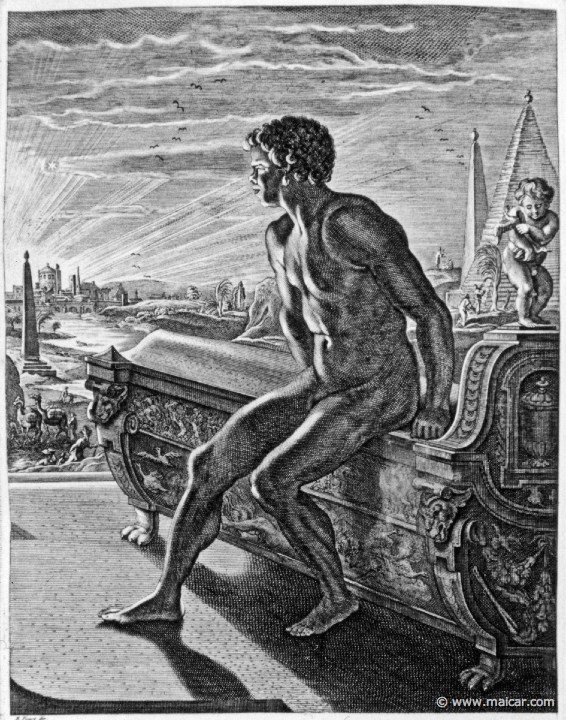
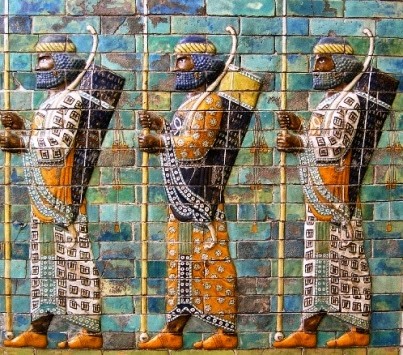
Achilles, Memnon, and the Trojan War In the 2018 American-British mini-series, Troy: Fall of a City, Achilles is played by the black British actor David Gyasi. Achilles was a white Greek. According to Homer’s description, Achilles had yellow hair. In the literary work, Ulysses the Sacker of Cities, after Achilles dies from Paris’s spear landing in his heel, Andrew Lang describe the Greek soldiers as “weeping and cutting off their long locks of yellow hair …” while the soldiers of Memnon1 are described as “a great army of men who had nothing white about them but the teeth, so fiercely the sun had burned on them in their own country.” In the depiction of Persian soldiers shown below, notice that even the palms of their hands are chocolate colored. In this same work, Memnon is described as “the most beautiful of men, except Paris and Priam, and his home was in a country that borders on the land of sunrising.” In other words, Memnon came from the East, not Africa. Depiction of Memnon below is by French Neoclassical engraver Bernard Picart.
Memnon, king of the Ethiopians and conqueror of the East. 3110: Memnon’s statue. Bernard Picart (1673-1733), Fabeln der Alten (Musen-Tempel), 1754
Thus, if the makers of this series wanted to put some black people in it, why didn’t they incorporate Memnon, warrior-king of the Ethiopians (burnt faces), and his numberless host of soldiers who traveled to Troy from Susa (present day Iran-Ancient Persia) to fight with the Trojans against the Greeks? Indeed, once he got to Troy, this black warrior-king would fight with Achilles in what became an epic battle of the ages, a great contest of evenly matched heroes. This epic battle had become a part of Greek legend even before the time of Homer (about 800 B. C.), being depicted by numerous Greek artists and in different mediums. Invariably, Memnon is depicted as black.
According to the account of the 3rd century epic poet Quintus of Smyrna, the fight between Achilles and Memnon was a draw until the goddess of discord and strife, Eris, intervened and “inclined the fatal scales of the battle, which no more were equal-poised” and Achilles thrust his sword beneath Memnon’s breast bone and killed him. At this, Memnon’s mother, the goddess of Dawn, Eos, took him away along with his great host of swarthy soldiers.
Persian Archers
Besides the Iliad and the Odyssey, Homer write a third epic poem, Aethiopis, which has been lost but Quintus of Smyrna evidently drew heavily upon it in writing Book II (Ethiopian Memnon) of his Posthomerica (Book II, 666).
What Difference Does It Make? The significance of this casting is that Hollywood is still presenting an erroneous picture of world history and the foundations of Western Civilization. Black People figured prominently in the early history of the Greeks. Their foundation legends invariably intersect with the black world of the Egyptians and the Ethiopians (Cushites or Kushites). There is no need to make Greeks black and blacks white like Greeks. Just tell it like it was. Some Ancient Greek writers took other Greeks to task for claiming things that should have been rightly attributed to Egyptians (the black-skinned, woolly-haired people described by Herodotus).
Diodorus Siculus, ancient Greek historian who lived during the first century B. C., made the following observation: “But now that we have examined these matters, we must enumerate what Greeks, who have won fame for their wisdom and learning, visited Egypt in ancient times, in order to become acquainted with its customs and learning. 2 For the priests of Egypt recount from the records of their sacred books that they were visited in early times by Orpheus, Musaeus, Melampus, and Daedalus, also by the poet Homer and Lycurgus of Sparta, later by Solon of Athens and the philosopher Plato, and that there also came Pythagoras of Samos and the mathematician Eudoxus, as well as Democritus of Abdera and Oenopides of Chios. 3 As evidence for the visits of all these men they point in some cases to their statues and in others to places or buildings which bear their names, and they offer proofs from the branch of learning which each one of these men pursued, arguing that all the things for which they were admired among the Greeks were transferred from Egypt.” (Library of History, Book 1, 96.1-3).
It’s time that academia and Hollywood come clean as Diodorus did 2,000 years ago. Just tell the truth.
The Featured Image is a 6th century B. C. depiction of Achilles and Memnon fighting. The legend of the battle between Achilles and Memnon goes back several centuries before this depiction. Title: Achilles and Memnon. Owner: Staatliche Antikensammlungen. Country of Origin: Greece. Date of Creation: 520 BC.(http://www.maicar.com/GML/Memnon.html)
… that Africans came to the Americas before Columbus? – Part IV – the Cultural Impact
The Africans who came to America before Columbus, over a period of 2,500 years or more, had a profound influence on American culture. The following are some of the probable areas of influence:
Pyramid building
Hieroglyphic writing
Religious practices
Language
Agriculture
Smoking
Before talking about the contributions, I invite you to view at the end of this essay the samples of “Negroid” individuals depicted by Ancient Americans. Some of these representations from Latin America precede Columbus by more than 2,000 years.
Pyramid Building
Interestingly the appearance of the pyramids and hieroglyphic writing in Mexico among the Olmecs is associated with the appearance of the massive Negroid heads. Van Sertima very effectively established the connection between Mexican pyramid building and Egypto/Nubian pyramid building. I discussed this in my previous blog post. Generally when scholars discuss the Central American pyramids, they will also mention Egyptian pyramids without making a connection because of the obvious similarities between the two.
Hieroglyphic Writing
A few examples of actual Egyptian hieroglyphs writing have been found in Mexico. Obviously Egyptian and Nubian flora, fauna, and other symbols were replaced by American flora, fauna, and symbols. Cheikh Anta Diop tells us that most of the animals and plants used in Egyptians hieroglyphs are from Nubia.
Religious Practices
Van Sertima makes the following observation:
“Some ritual practices that are almost identical in America and Egypt, which we may safely date from the Olmecs onward and which point to an outside influence, are the wearing of false beards by high priests, the ritual use of purple as an exclusively royal and priestly color, incest between royal siblings and a complex of royal paraphernalia, such as the ceremonial umbrella and litter and the bird-serpent motif in coats of arms and royal diadems.” (They Came Before Columbus, p. 164)
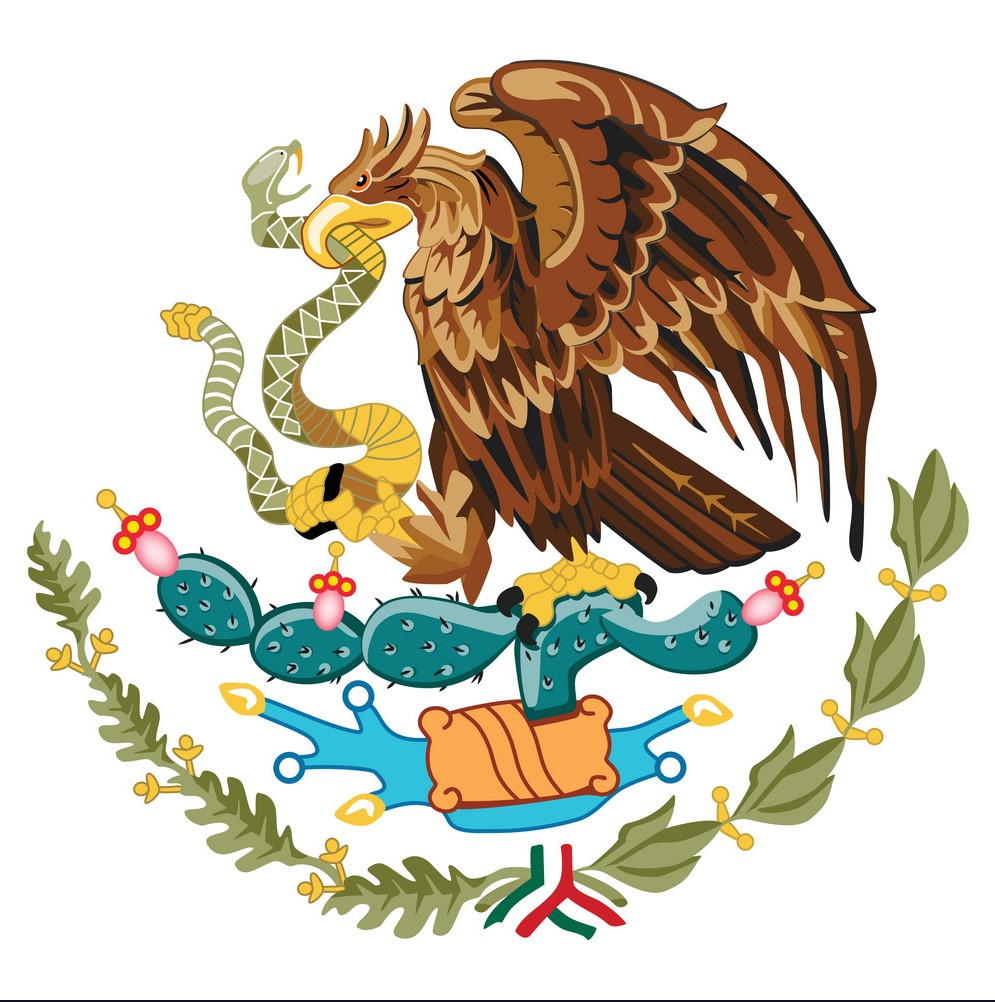
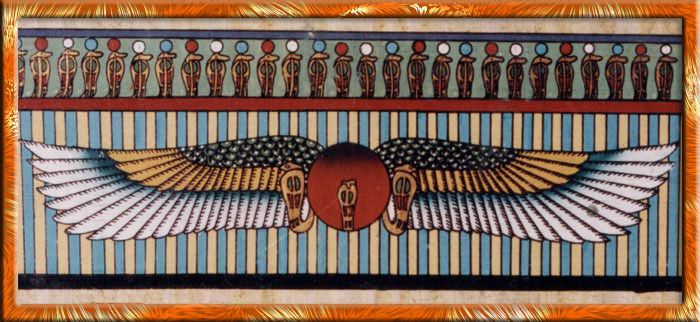
Thus the plumed serpent, or bird-serpent, motif (a part of religious symbolism of Mexican religious practices going back to the Olmec civilization), appears to be an African import from Egypt. Van Sertima posits that the bird-serpent motif comes from inner Africa where we find the secretary bird who is the mortal enemy of snakes. Eagles, and probably other birds of prey, kill snakes but none can approach the ferocity and deadliness of the African secretary bird in dealing with snakes. In Egyptian symbolism, the Horus Falcon or Hawk (one of the titles of the pharaoh was Hawk of Nubia) replaces the secretary bird. The fight between Horus and Seth may be viewed as the battle between the hawk (or falcon) and the serpent, the representation of evil. In the end Horus wins, good overcomes evil. This motif is incorporated into Egyptian royal symbolism in the winged sun disc.1
As we come up to the time of the Aztecs, the Middle Ages, we see the bird-serpent motif associated with the Aztec god Quetzalcoatl. Indeed, quetzal means bird or plume and coatl means serpent. An eagle killing a snake at the spot where Tenochtitlan (center of Mexico City) was founded is part of the founding legend for the modern state of Mexico. Hence the coat-of-arms of Mexico incorporates an eagle standing on a cactus fighting a rattle snake (See Featured Image at the top of this post).
Because Emperor Ababukari and his Mandingos landed on the shores of Mexico exactly six cycles after the last appearance of Quetzalcoatl, the Aztecs took him to be the reappearance of that god. The fact that as the Emperor’s ship came in “they could see quite clearly the outlines of a great golden bird” (p. 74) served as further confirmation that this black man from a land burning in the white heat of the sun must be the reincarnation of Quetzalcoatl. This explains why Quetzalcoatl was sometimes represented as black.
While doing research for a work for a comparative grammar on American languages, Leo Wiener noticed that some TV words had a foreign origin, some European and some African. In the area of magic and religion, he claimed to show “… by documentary evidence to what extraordinary extent the Indian medicine-man owes his evolution to the African medicine-man …”2
Language
Wiener demonstrates that the American words for banana, yam, sweet potato, manioc (cassava), and tobacco in American languages are of foreign origin. He shows that the word for tobacco was introduced to the Americans by Africans and is of Arabic origin and concluded that “Indeed, when we turn to the appellations of the sweet potato yam in America, we find nothing but African forms.” (Wiener, p. 262). Van Sertima reinforces Wiener’s conclusions. The linguistics analysis of these transfers is quite complicated. I refer you to Van Sertima and Wierner for some very illuminating discussions.
Agriculture
The following are some of the crops introduced to America from Africa.
An African species of cotton (Gossypium herbaceum) was introduced to America during the 4th millennium (between 3,000 and 4,000) B.C. and crossed with a wild New World cotton “to form the New World tetraploid cotton…” This was accomplished by an “… African man, bearing cotton seed, made the drift journey to the Americas in the fourth millennium B.C.” (Van Sertima, p. 193). Scientific experiments proved that the cotton seed could not have gotten here by floating in the ocean. That is why Van Sertima concluded that an African man had to have brought the G. herbaceum cotton seed to America. Additionally this is indirect evidence of a very early African contact with the Americas.
We know for certain that the cultivation of the yam originated in Africa, probably West Africa, and, therefore, was a transplant to the Americas.
Wiener concluded that “Indians learned the cultivation of manioc (cassava) from the Congo Negroes … “(p. 248).
In her seminal work, Black Rice: African Origins of Rice Cultivation in the Americas, Judith Carney argued for, and conclusively demonstrated, the primacy of African rice and skills in rice’s development in the Americas. She noted that “A knowledge long practiced in West Africa was brought with slaves across the Atlantic” (p. 2). It stands to reason that this same knowledge was transferred by Africans who came to America before Columbus, especially since the Mandingos are prominently mentioned as one of the African people who came to places such as Veracruz in Central Mexico. The Mandingos, being descendants of the people of the West African medieval empire of Mali, would have had intimate knowledge of rice cultivation. The village that Carney accidently discovered south of Veracruz is called Mandinga and the villagers were Afro-Mexicans living in an areas where rice had been grown.
Smoking
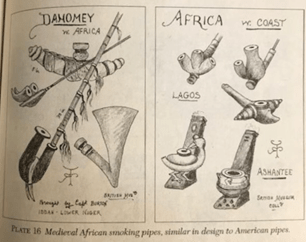
Wiener first notes that “there arose in Africa the habit of smoking.” (p. 112) In other words, Africans invented the habit of smoking but did not domesticate tobacco; domestication is attributed to Arabs. Wiener goes on to say that “… there can be little doubt that the pipe was equally introduced by them [Africans] into America, and that the Arawaks and Negroes carried it north, to Florida, together with tobacco.” (p. 177). Van Sertima comes to the same conclusion, namely, that Africans introduced the Native Americans to pipes and the smoking of tobacco. The Africans made pipes with an artistic flair, usually decorated with animals. The fact that some of the early pipes in America were decorated with elephants was further proof that these pipes were made or inspired by Africans. No elephants are native to America.
This brief list of African contributions to the culture of the Americas is by no means exhaustive. It does not address transfers such as iron-working that undoubtedly occurred during the slave era.
Notes and References
Below is an example of an Egyptian winged sun disc
2 . African Medieval Pipes
Von Wuthenau, Alexander (1975). Unexpected faces in Ancient America: The historical testimony of Pre-Columbian artist (1500 B. C. – 1500 A. D.).
Van Sertima, Ivan (1976). They came before Columbus: the African presence in Ancient America. New York: Random House Trade Paperbacks, pp.145-155.
Wiener, Leo (1920). Africa and the discovery of America. Philadelphia: Innes & Sons, Forward.Carney, Judith A. (2001). Black rice: African origins of rice cultivation in the Americas. Cambridge, Massachusetts: Harvard University Press.
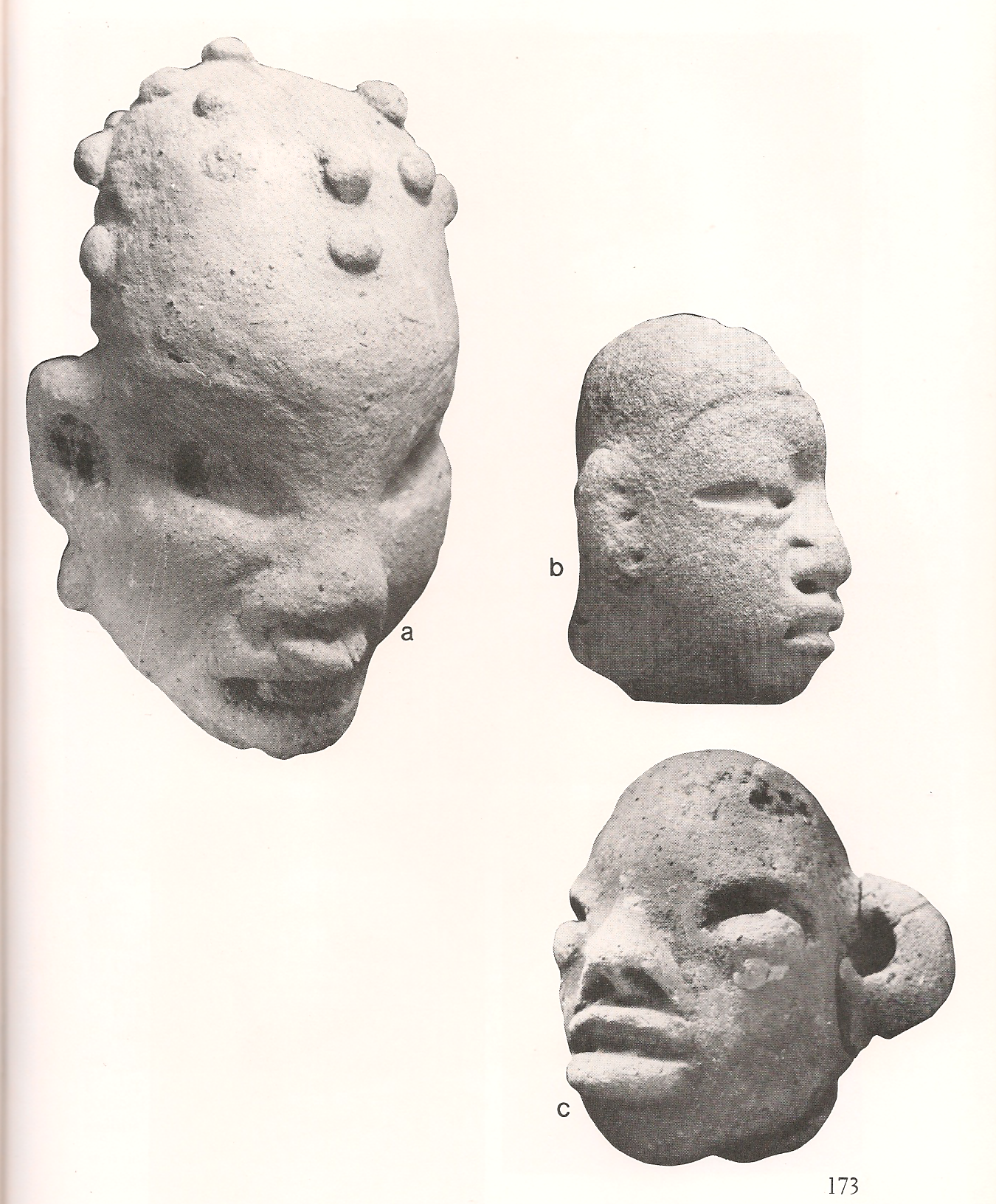
1. Three Terracotta heads from Mexico
92. a. Terracotta head from Morelos, Mexico, Pre-Classic. This piece shows an African hair style and nose ring. b. Terracotta head from La Venta, Tabasco, showing kinky hair, Museum Villahermosa, Tabasco. Height 7 cm. c. Pre-Classic head from Kaminaljuyu, Guatemala. Source: Von Wuthenau
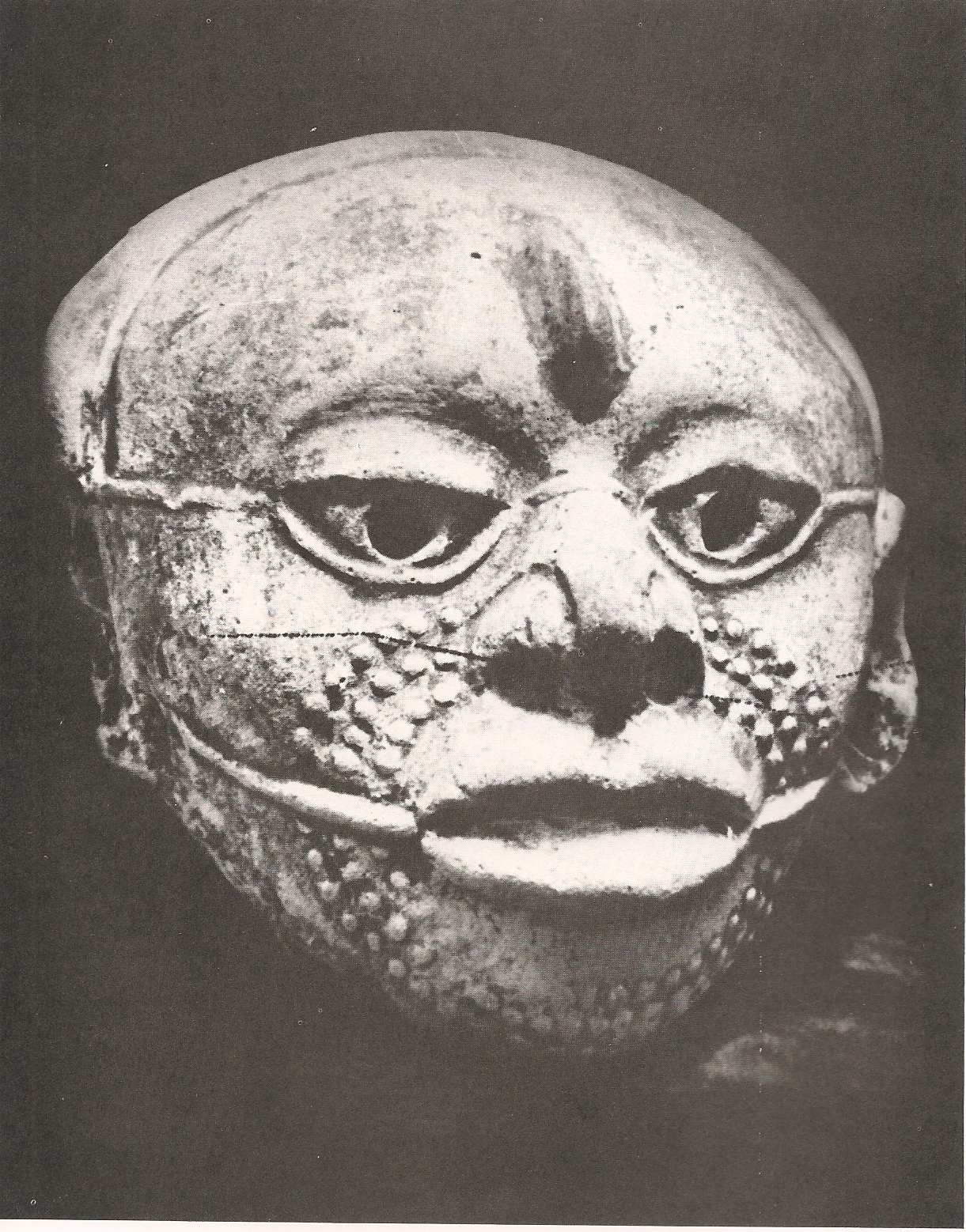
2. Tattoo with Scarification Tattooing
106. Veracruz Classical terracotta head with scarification tattooing. The eye technique resembles earliest Nock-style terracotta from Nigeria, Africa. Height 11 cm. Source: Von Wuthenau
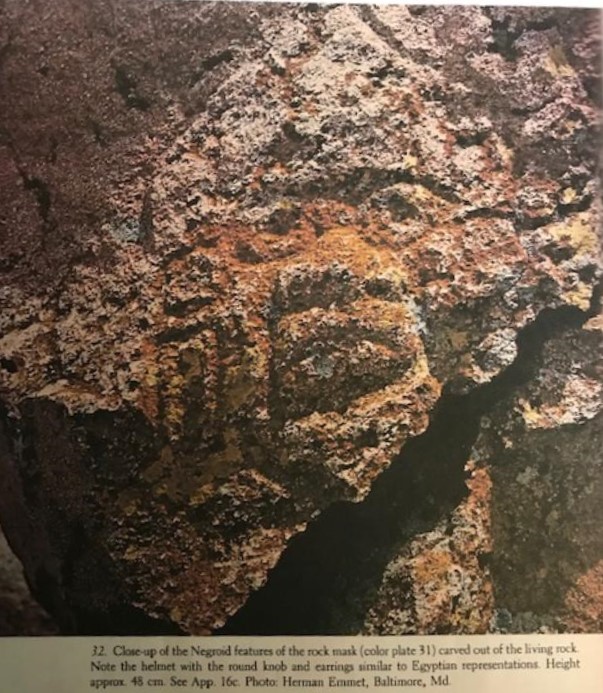
3. Mountain Rock Face at Morelos
Source: von Wuthenau Von Wuthenau makes the following observations about this rock carving, “Recently an incredible rock carving was discovered on a mountaintop in the state of Morelos, Mexico … For us the most unexpected surprise was a big stone face carved out of the living rock, situated above all the other reliefs in the same place. For almost 3,000 years this face has been gazing over the vast valleys of Morelos in the direction of the snow-covered peak of Pococatepetl, Mexico’s famous volanco. The features of the face are indisputably Negroid.” (p. 136)Source: von Wuthenau












 Why Didn't They Tell You?