


... about the causes and sources of the wealth of the fabled West African empires and cities of late antiquity and the middle ages?
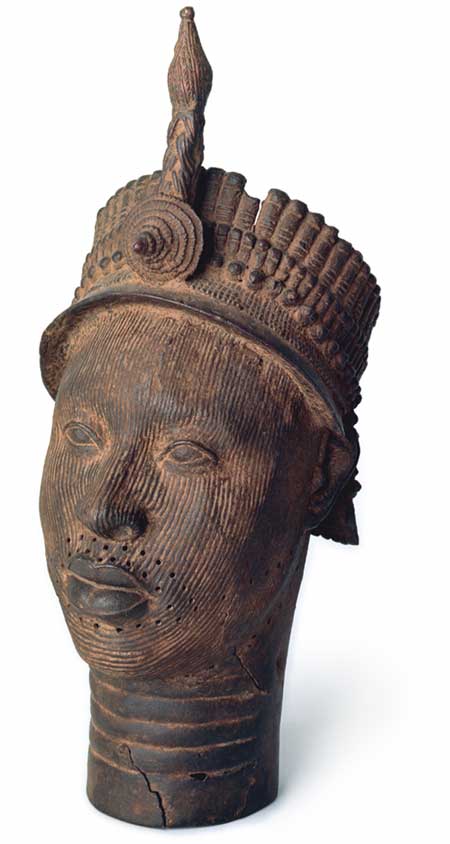
Featured Image: Bronze head of a Benin noble man
Why didn’t they tell you about the causes and sources of the wealth of the fabled West African empires and cities of late antiquity and the middle ages?
The purpose of this post is to give some indication of what was going on in the areas where people were taken from during the Atlantic Slave trade from the 1500’s to the 1800’s. The important empires of Ancient Ghana, Mali, Songhay, Benin, and Kanem/Bornu were located in areas of West Africa where the slave trade operated. West Central Africa was another significant area of slaving where a large number of Africans brought to the Americas were taken from. Impressive empires and cities in Southern Africa and East Africa include Benametapa (modern Mozambique and Zimbabwe), Mapungubwe, Niekerk, Inyanga, Penhalonga, Dhlo Dhlo, Khami, and Naletali. My comments will focus on the West African empires of Ghana, Mali, and Benin. Ancient Ghana and Ancient Mali were located in the Sahel region of West Africa, an area that borders on the southern edge of the Sahara. The modern country of Mali was part of both of these empires. On the other hand, the Empire of Benin was located in the forest zone of West Africa, being mostly in the modern-day country of Nigeria.
First I want to share with you an important substantive conclusion, about Africa, that the late great historian Dr. John Hope Franklin came to more than seventy (70) years ago when he said, “The basic problems of existence had been solved. Almost everywhere there were stable political, economic, and social institutions whether the states were great empires such as that of Songhay or mere political entities such as Katsena of the Hausa States, they were elaborately organized with limited monarchies and a myriad of public officials. Well-defined concepts of law and order prevailed”1.
I quote the above passages from Dr. Franklin because a pre-requisite for economic prosperity and economic growth is economic stability along with a well-defined legal system. Without these conditions being present there can be no lasting economic prosperity and economic growth. What Dr. Franklin tells us is that the pre-European African societies met these pre-requisites. Before looking at the other factors making for economic growth and prosperity, I will share some of the comments of Arab and North African travelers to West Africa during Medieval times and of early European travelers to Benin, giving you a glimpse into what these societies were like 500 to a 1,000 years ago.
Ancient Ghana
Ancient Ghana’s beginning almost certainly goes back before the time of Christ but for certain, around 800 A.D., it was on the map because the ancient geographer El Fazari “soon after A.D. 800 named it “land of gold””2. Shortly before 833 when Kwarizmi marked it on a map …” Over the next 200 years, Moslems from Spain and North Africa would continue to visit Ghana. The geographic location of Ancient Ghana is not the same as modern Ghana. Writing from Cordoba, Spain in A. D. 1067, El Bekri published a history of Ghana compiled from numerous sources considered to be very reliable.
Here are some of the things El Bekri said:
“The king of Ghana … can put two hundred thousand [200,000] warriors in the field, more than forty thousand [40,000] of them being armed with bow and arrow”3… If this be true, then the empire had to be extremely wealthy to be able to muster such a huge military force. Economic power and military power go hand-in-hand.
The description of the king holding court gives another indication of the wealth and greatness of this ancient empire:
“When he gives audience to his people, to listen to their complaints and set them to right, he sits on a pavilion around which stand his horses caparisoned in cloth of gold; behind him stand ten pages holding shields and gold-mounted swords; and on his right hand are the sons of the princes of his empire, splendidly clad and with gold plaited into their hair. The governor of the city is seated on the ground in front of the king, and all around him are his vizirs [ministers] in the same position. The gate of the chamber is guarded by dogs of an excellent breed, who never leave the king’s seat, they wear collars of gold and silver. … The beginning of an audience is announced by the beating of a kind of drum which they call deba, made of a long piece of hollowed wood.”4 (p. 85)
The capital (Kumbi) consisted of two cities: a wealthy walled city where the king resided and a city for Moslem merchants with twelve (12) mosques. The two cities were six miles apart
After a 14-year war, Ancient Ghana was brought down by Islamic invaders from across the Sahara, Almoravids, around the time El Bekri published his history of Ghana. The capital city was taken in 1076 A.D., almost 1,000 years ago. These invaders were primarily blacks led by a black General, Abu Bakar. The successor state to Ghana was Mali, which incorporated an even larger territory into its empire than Ghana.
Ancient Mali
An indication of the wealth of Mali are the ocean voyages commissioned by its emperor Abubakari in the early 1300’s and the lavish pilgrimage to Mecca by Abubakari’s brother Kankan (Mansa) Musa in 1324. Emperor Abubakari believed that if you sailed west from his empire across what we now call the Atlantic Ocean, you would eventually hit land, the New World of the Americas to which Christopher Columbus sailed almost 200 years later, 1492. Therefore, he put together a fleet of two hundred ships filled with men and another two hundred filled with gold, water and food for two years. After a long period of time, one ship came back and reported that the other ships were caught up in what looked like a river in the ocean and disappeared. The captain of the ship was able to turn around and report what happened. In spite of the tragedy, the Emperor Abubakari would not give up and equipped an even bigger fleet of 2,000 ships and he himself led the expedition. Though he never returned to Mali, historian Ivan Van Sertima (They Came Before Columbus) makes a convincing case for his having made it to the Americas, Mexico in particular. He told his brother Kankan Musa that if he did not come back within a certain amount of time, he was to assume the kingship. This Kankan Musa is the same one that made the famous pilgrimage to Mecca and spread so much gold along the way that he disrupted the economies of the Middle East, causing an inflation that took them years to recover from. Several years ago, he was touted in the media and on the internet as being the richest man that ever lived. Whether or not he was, indeed, the richest man that ever lived, it is clear that the empire had to be extremely wealthy for those emperors to undertake those massive enterprises.
Empire of Benin
The following are Basil Davidson’s excerpts from a book published in 1668 called Descriptions of Africa by an Amsterdam geographer, Olfert Drapper. This is a description of the Empire of Benin before 1668:
“The Empire by that time, according to these witnesses [Dutch travelers], measured some four hundred fifty miles from west to east and an unknown distance toward the north, having “many towns and an infinity of villages, the capital city itself being enclosed on one side by a wall ten feet high, made of a double palisade of trees” pierced by several gates eight or nine feet high and five feet wide,” each made of a single piece of wood and turning “on a stake”. Like the empires of Ghana and Mali, this empire was larger than most nations of today.
“The King’s palace,” these Hollanders reported, “is on the right side of the town … [being] a collection of buildings which occupy as much space as the town of Harlem,” with numerous apartments and fine galleries “most of which are as big as those on the Exchange in Amsterdam.” These galleries “are supported by wooden pillars encased with copper, where their victories are depicted …” while the corner of each gallery roof “is adorned with a small pyramidal tower, on the point of which is perched a copper bird spreading its wings.” The whole town “is composed of thirty main streets, very straight and 120 feet wide, apart from an infinity of small intersecting streets,” the houses being “close to one another, arranged in good order …”: and “these people are in no way inferior to the Dutch as regards cleanliness” —- no mean tribute from the member of a nation that was probably, in point of cleanliness, the most advanced in the Europe of its day.”5
The dominant ethnic group of Benin was the Yoruba who are today a nation of some 50 million people, most of which reside in southwestern Nigeria, eastern Benin, and Togo.
There were several important economic factors common to all three empires (Ghana, Mali, and Benin) as well as other medieval African states: agriculture, specialization and division of labor, trade (regional and international), iron-making, and skilled artisans. All of these factors mutually supported each other and resulted in prosperity that could support a large population.
No country has achieved a high level of production and achieved a high standard of living for its people without specialization and trade. At the micro or individual level, instead of being the jack of all trades but master of none, each person specializes and performs those tasks they are best at doing. Blacksmiths stick to producing iron while rice farmers stick to growing rice. So doing results in more iron and more race being produced than would be the case if each person tried to produce both iron and rice. I use rice and iron in my illustration because those two items constituted important industries in both Ghana and Mali.
Specialization, division of labor, and trade (exchange) go together. The iron maker needs rice; therefore, he sells iron to get the rice he needs. This only happens when markets reach a certain size. You need dense populations for this to work and that was the case in many areas of Sub-Sahara Africa. Having a currency facilitates trade. Various commodities were used as money in Ghana and Mali; gold, cowrie shells, and metal bars were some of the things serving as currency.
African societies took specialization to a high level; villages specialized according to what they did best. Beyond the village level, there was regional specialization and international trade. By the middle Ages, gold was moving from the forest zone of West Africa (where gold was in abundance) to the international trading centers of Ghana. Though Ghana, like Mali later, did not control the production of the gold, it controlled the trade in gold. The gold was exchanged for salt and manufactured goods from North Africa and Europe. Eventually much of that gold from the West African forest zone ended up in Europe, thereby fueling expansion in Europe. The Empire benefited from all this because import and export duties (sometimes called tribute) were imposed on the goods traded. The fact that the King of Ghana had built a city in the capital (Kumbi) for Moslem traders shows the importance of international trade to Ghana.
I will end by noting that a recurring observation of travelers to Africa before and at the beginning of the slave trade was the dense populations they encountered. Africa had people, lots of people, and it could support its people because its societies were stable and well organized making for prosperous economies. Important crops and food sources in West Africa: rice, millet, sorghum, yams, fonio, beans and peas such as black-eyed peas, and different types of vegetables and greens, not counting livestock and fisheries in many areas. Many of these crops such as rice (oryza glaberrima), black-eyed peas, pearl millet and okra were domesticated in Sub-Sahara Africa. Indeed, the area from Senegal down to about Liberia was known at one time as the Grain Coast or the Rice Coast. They produced enough cereal grains to sell provisions to the slavers for their return voyages with their damnable cargos. For more than 200 years, they just kept going back over and over again taking away millions and millions of men, women, and children from the Continent. By the middle of the 19th century, the wonderful things that the people of the Western Sudan had built were mostly destroyed.
More to come.
- John Hope Franklin, From Slavery to Freedom, pp. 37-38.
- Basil Davidson, The Lost Cities of Africa, p. 83.
- Davidson, Lost Cities, p. 84.
- Davidson, Lost Cities, p. 85.
- Basil Davidson, The African Past, pp. 179-180
 Why Didn't They Tell You?