


... in the 1950’s, libraries did not have many books on black people.
Why didn’t they tell you that in the 1950’s, libraries did not have many books on black people.
In 1956, my immediate family moved from the Mississippi Delta (Mound Bayou) to San Bernardino, California. My three oldest sisters stayed behind because they were married and had good-sized families; one had 4 children and the other two had 6 each. Seven older brothers were already living in Southern California, Los Angeles or San Bernardino. My parents and the 6 children still living at home made the move.
Going from all black segregated schools to integrated California schools required an adjustment but the adjustment was relatively easy. Right after we got there, I began to focus on books and school. I decided that I was going to college and, therefore, went about getting myself ready by excelling in school and by reading and increasing my vocabulary. The schools I attended in Mississippi gave me a sound basic literacy in the three R’s: reading, writing, and ‘rithmatic.
While in junior high and high school, I tried hard to get a summer job, but nobody would hire me, in spite of my being a willing and able worker. Therefore, most of my summers were spent in the library and going swimming at Perris Hill Swimming Pool.
During that time, I developed an interest in learning more about the history of black people. Therefore, I diligently searched through the stacks at the San Bernardino Public Library for books about black folk, almost to no avail. I only found a few things I considered useful. I did the same thing at the San Bernardino High School Library with the same result. I did find at the public library one jewel, the book Black Odyssey: The Story of the Negro in America by Roi Ottley. It was in that book that I found out about Thomas Jefferson’s children by a slave woman. Therefore, I was somewhat puzzled when 50 years later this information about Jefferson was treated as a new revelation. I knew about it from reading Ottley’s book.
I was not just interested in the history of black people in America but also African history, especially pre-European African history. While enrolled as an undergraduate at Michigan State University, I took a two-quarter sequence African History course. There were two interesting, and somewhat surprising, things about this course. First, I was the only black person in a class of about 70 students (out of around 30,000 students, between 500 and 1,000 were black students). One could conclude that at that time, the early 60’s, black students were not too interested in African history. The second thing is that the course started with the European presence in Black Africa. I was hoping to find out something about pre-European, pre-colonial Africa but Dr. Hooker, a nice, cultured gentleman, did not even talk about early European explorers’ descriptions of the societies they found, which are quite interesting and revealing.
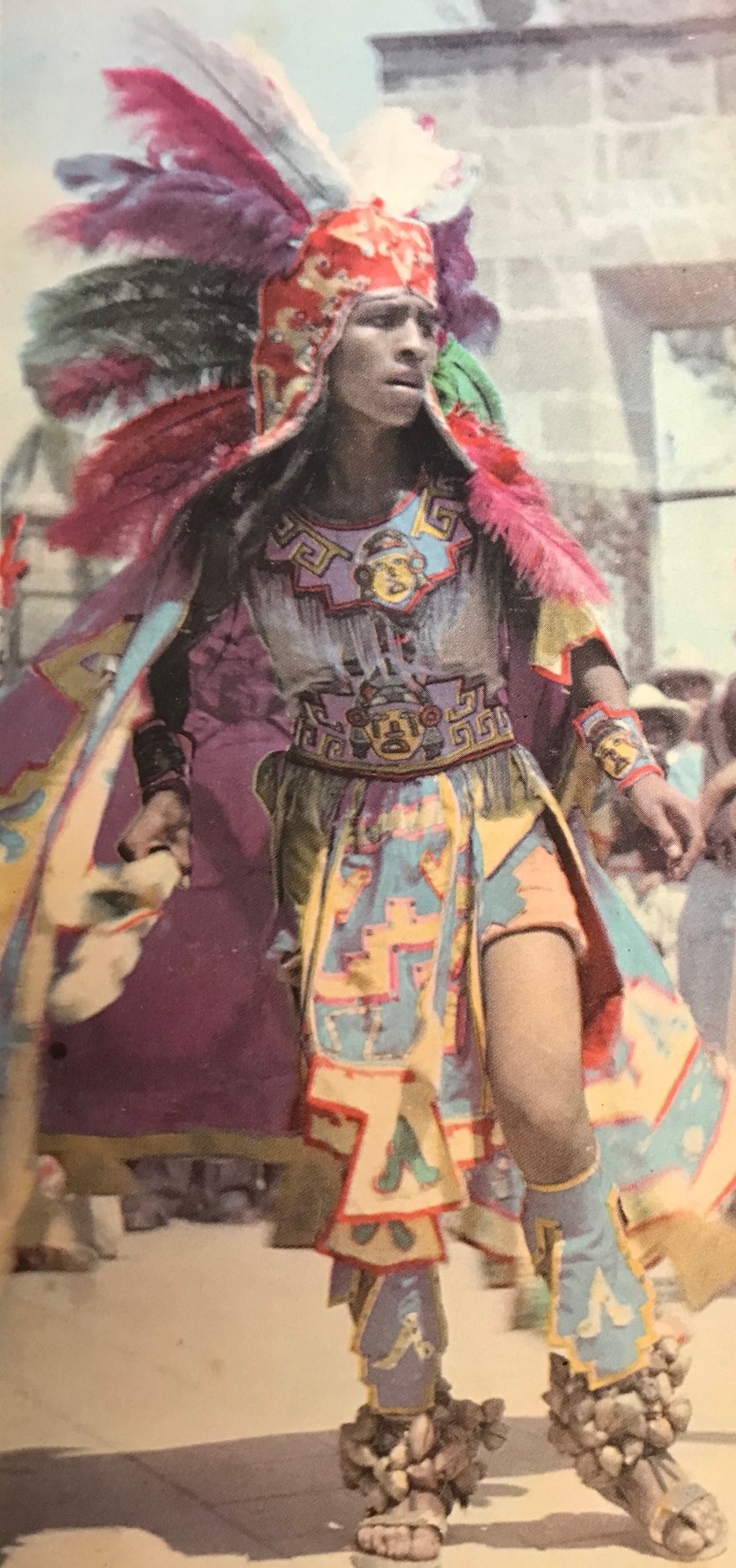
Over the years, through personal searches and research and through networking with other Black People interested in black history, I have acquired some knowledge of the history of Black People. My thirst has been lessened but not completely quenched. It’s interesting how little things can intrude to get you thinking. For in my second-year Spanish class, we had a book (El Camino Real) with a picture in the front of an Aztec dancer (pictured at the front of this article), a handsome young man that I immediately dubbed a Negro, term used then. That was the immediate assessment of a 15-year old boy. But the question was: what was he doing in Mexico? Over the years I found out that it could be explained at least in two different ways. One was he could have been the descendant of one of the Mandingo (his build seems to fit that of the Mandingos) Africans that the Spanish brought into Mexico as slaves beginning in the 1500’s, starting almost a 100 years before 1619 Jamestown. Alternatively his descendants could go back to the middle ages, 1300’s, when evidence indicates that Mandingos of the Empire of Mali had contact with Mexico, in the state of Vera Cruz.
One other thing comes to mind in reminiscing about that period. When I was taking geometry in the 10th grade, I developed an interest in the Pythagorean Theorem. Our geometry teacher, Mr. Keck, gave us an extra credit assignment to do the Euclidean proof of the Pythagorean Theorem; we had to demonstrate it on the board before the whole class. I took him up on it and did it. At that time, it never occurred to me that geometry itself had been invented by Africans along the Nile. The Greek father of history Herodotus and the ancient Greek scholar Diodorus of Sicily are unequivocal in asserting that geometry was invented in Egypt and from there passed into Greece. Indeed, Diodorus chided his fellow Greeks for taking credit for things they had learned in Egypt. Nobody told me that.
More is coming.
 Why Didn't They Tell You?